
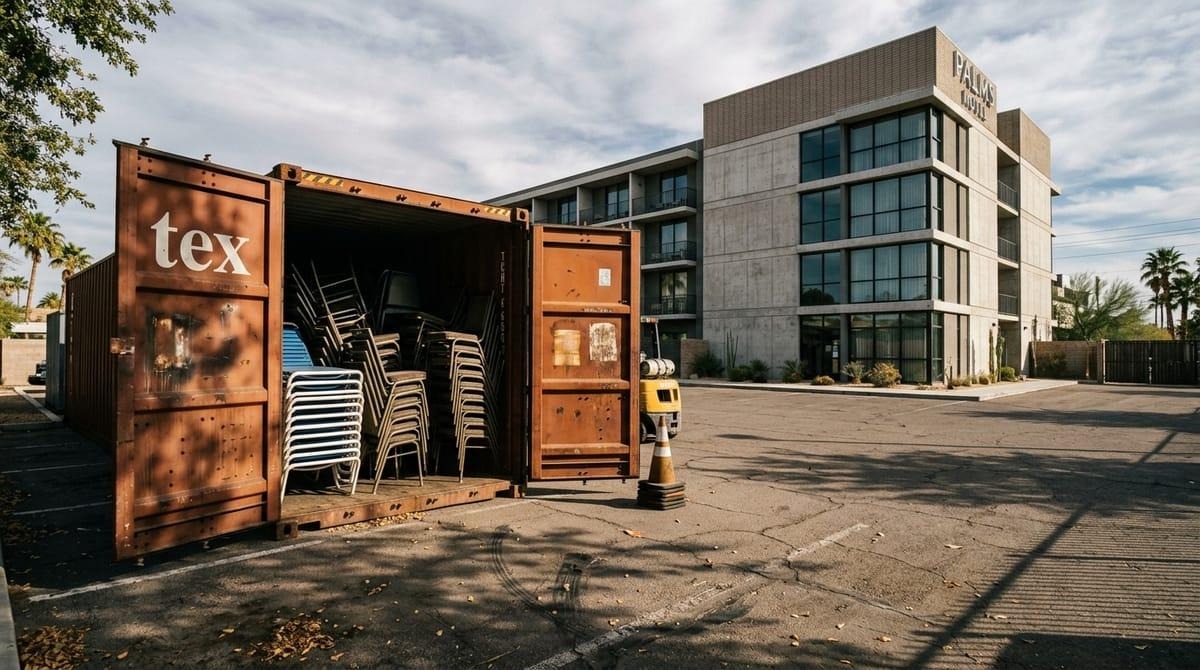
Hotels run out of storage space long before they run out of guests. Banquet halls don’t have room for off-season chairs. Pool decks can’t hold thirty stacked lounges in November. And mid-renovation, the FF&E (Furniture, Fixtures, and Equipment) coming out of guest rooms has to live somewhere that isn’t a function room, a hallway, or a warehouse forty minutes off-property.
Shipping containers for hotel storage solves that problem. A 20-foot or 40-foot cargo container parked behind the building gives hospitality teams a secure, weatherproof space for furniture during renovations, seasonal inventory like pool gear and holiday decor, and banquet overflow that the indoor storage rooms can’t handle. Hotels across Florida and Georgia have been using them for years, the same way contractors, government properties, and agricultural operations already do.
This guide is written for hotel facility managers, owners, and property management teams who are looking at shipping containers as a storage option and want to know what they’re getting into before requesting a quote. It covers the two container grades worth considering for hospitality use, the dimensions and capacity differences between a 20-foot and a 40-foot unit, site planning questions like asphalt protection and guest sightlines, security and ventilation for soft goods like mattresses and linens, the math on owning versus renting, and the operational details around permits, hurricane prep, and delivery.
At E&S Equipment Sales, we’re a family-owned shipping container company that has served hotels, resorts, and the hospitality industry throughout Florida and Georgia since 2010. Better Containers, Professional Service, that’s the standard we hold every container to. We’ve sold & delivered more than 11,000 containers, and hospitality sits alongside government, auto dealers, and commercial construction as one of the core industries we work with every day.
Not a hotel manager? Check out our other guide on renovation storage options.
Why hotels use shipping containers for on-site storage
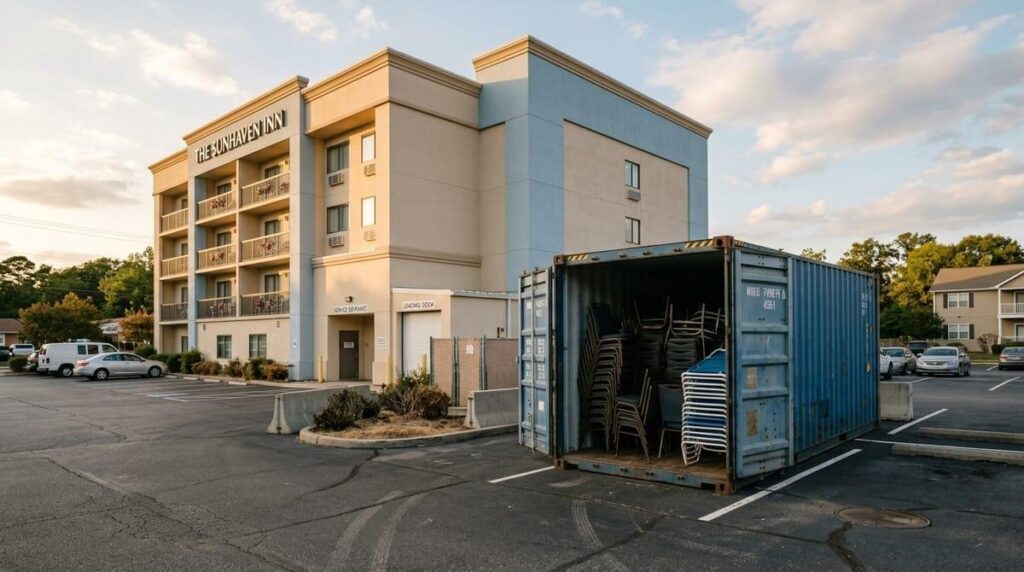
Most hotels run out of storage space before they run out of guests. Banquet halls don’t have room for off-season chairs. Pool decks can’t hold thirty stacked lounges in November. Renovation timelines slip because the FF&E warehouse is full and the new shipment arrives anyway.
A 20-foot or 40-foot cargo container on the property solves the geometry problem. Steel walls built to cross oceans with 60,000 pounds of cargo. Cargo doors that lock with heavy-duty hardware. A footprint smaller than three parking spaces. Once the container is on-site, the storage friction that quietly drags on hospitality logistics disappears.
For larger commercial hospitality operations, our commercial container solutions page covers the full spectrum of business uses we’ve supported across hotels, government properties, auto dealers, and agricultural operations.
Secure staging for renovations and FF&E moves
Hotel renovations are organized chaos. Furniture, fixtures, and equipment have to leave the rooms before crews can work, and they need to come back in the right order. If your team is stacking nightstands in a function room or piling chairs in a hallway, you’ve got a guest experience problem on top of a logistics one.
A shipping container parked behind the property keeps everything organized, locked, and out of view. Floor 2’s FF&E goes in one container, Floor 3’s in the next. When the new install starts, it pulls out in the same sequence it went in. Temporary storage for hotel remodels stops being a logistics afterthought and becomes part of the project plan.
For larger projects spanning multiple floors or wings, properties usually stage two to four 40-foot units. Cheaper than monthly rent on an off-site warehouse, plus you skip the labor cost of trucking pieces back and forth.
Seasonal storage for pool, patio, and holiday inventory
Florida properties run their pool decks ten months a year. The other two, those lounges, umbrellas, daybeds, and side tables have to go somewhere. Indoor storage rooms get raided for the season, leaving housekeeping and engineering teams scrambling for shelf space.
A 20-foot container on the property handles storing seasonal hotel pool furniture cleanly, with the gear protected through hurricane season. Same logic applies to holiday decor, conference furniture, and outdoor event setups. The container becomes the seasonal closet the hotel was missing.
Overflow capacity for banquet and event operations
Banquet ops always need more space than the property gives them. Round tables, chiavari chairs, linens, AV equipment, dance floors, staging. A single corporate event can take up an entire ballroom storage room and still leave gear in the hallway.
Weatherproof storage for banquet supplies in a 40-foot container handles overflow for the largest catering operations. Wedding venues attached to hotels use them to stage linens and centerpieces for upcoming events without competing for indoor space. And when engineering needs a replacement headboard at 9 PM for a guest complaint, it’s in container two, third from the back. Not at a warehouse forty minutes away.
Which shipping container grade fits your hotel
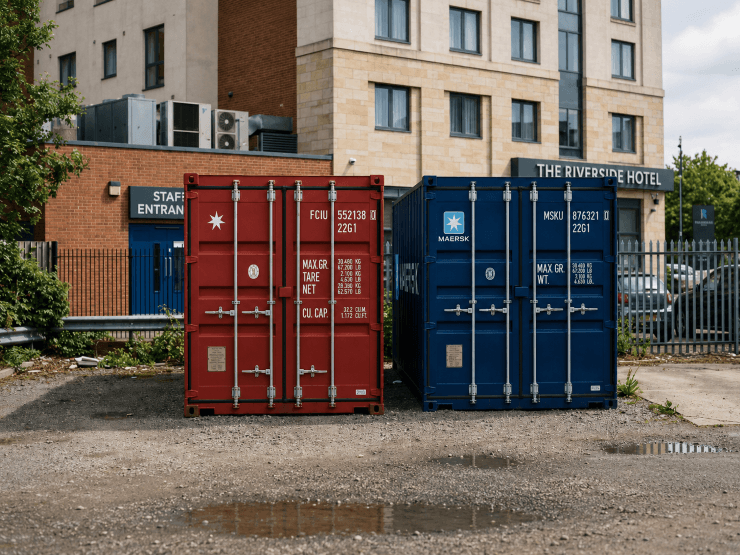
Buying a shipping container can feel like buying a used car. The same size unit shows up in four different grades, prices swing thousands of dollars, and brokers are happy to sell you whatever they have. For hotel storage, two grades cover almost everything.
Cargo Worthy used containers are the workhorse for back-of-house hospitality storage. These steel shipping containers meet US Coast Guard requirements for international cargo shipping, which means 95 percent or better structural integrity, sound flooring, working cargo doors, and no leaks. Expect surface paint chips and minor dents from past service, but they’re priced well below new units and handle any storage application a hotel needs. Right call for FF&E during renovation, pool furniture, banquet overflow, and grounds equipment.
New One-Trip shipping containers are factory-fresh units manufactured in China, loaded with cargo for one trans-Pacific voyage, then sold here. They look essentially new, take custom paint beautifully, and run a five-year structural warranty. The right pick for any guest-visible application like container poolside bars, mobile front-desk setups during a renovation, or brand-conversion staging units parked near the entrance.
A couple of grades you’ll see online aren’t worth considering. As-Is containers come without any condition guarantee. Wind/Water Tight units sit below Cargo Worthy on the quality scale and can’t be certified for ocean shipping. We stock the two grades we recommend in-house, and every container leaving our depots is water tight, fully operational, and guaranteed regardless of price point. If a full breakdown of every grade and what to look for helps before you decide, our container conditions guide covers it in depth.
20-foot vs 40-foot hotel storage containers
E&S stocks 10-foot, 20-foot, 40-foot, and 45-foot containers. For hotel storage, the 20-foot and 40-foot handle most of the work, with 40-foot high cube units coming in when extra vertical clearance matters.
| Specification | 20-foot standard | 40-foot standard | 40-foot high cube |
| Exterior dimensions | 20 ft L × 8 ft W × 8 ft 6 in H | 40 ft L × 8 ft W × 8 ft 6 in H | 40 ft L × 8 ft W × 9 ft 6 in H |
| Interior dimensions | 19 ft 4 in L × 7 ft 8 in W × 7 ft 10 in H | 39 ft 5 in L × 7 ft 8 in W × 7 ft 10 in H | 39 ft 5 in L × 7 ft 8 in W × 8 ft 10 in H |
| Cargo door opening | 7 ft 8 in W × 7 ft 5 in H | 7 ft 8 in W × 7 ft 5 in H | 7 ft 8 in W × 8 ft 5 in H |
| Floor area | ~146 sq ft | ~296 sq ft | ~296 sq ft |
| Interior volume | ~1,170 cu ft | ~2,390 cu ft | ~2,700 cu ft |
| Tare weight | ~4,800 lbs | ~8,200 lbs | ~8,750 lbs |
| Best for | Pool and patio inventory, holiday decor, single-floor renovation phases | Full guest-room floor FF&E, banquet overflow, multi-floor refreshes | Oversized fixtures, vertical stacking of headboards and mirrors |
20-foot storage containers for tight hotel parking lots
The 20-foot container is roughly the footprint of a parking space, which makes it the natural pick for properties with limited yard space, urban hotels with packed service drives, or boutique properties trying to keep the container out of sightlines. About 146 square feet of interior storage, eight and a half feet tall, easy to tuck behind a building, near a loading dock, or along the edge of a back lot.
A 20-foot unit handles the FF&E for roughly a 10 to 14 room single-floor renovation phase. Pool storage at a 100-room hotel rarely needs more than a single 20-footer. For properties that just need a dedicated home for seasonal pool furniture and event overflow, this is usually the right size to start with.
40-foot shipping containers for full-floor FF&E renovations
The 40-foot is the workhorse of hospitality storage. Twice the length of the 20-foot, same height, and the high cube version gives you an extra foot of vertical clearance for stacked furniture or oversized fixtures.
A 40-foot shipping container handles a full guest-room floor of 20 to 28 rooms (beds, dressers, nightstands, headboards, mirrors). Multi-floor renovations, full property refreshes, and big banquet operations all default to 40-footers. Brand-conversion projects under tight phase deadlines typically stage two to four of these units side by side, with each one assigned to a specific floor or zone.
For properties with door-clearance issues or oversized FF&E pieces, our seven specialty cargo container configurations include open-side, double-door, and high cube units that solve access problems standard cargo doors can’t. Open-side containers in particular work well for hotel storage where forklift access from the long edge beats backing in through the end doors.
Where to place your hotel storage container
Where the container sits on the property matters more than most hotels realize until delivery day. Three things drive that decision.
Protecting your asphalt parking lot
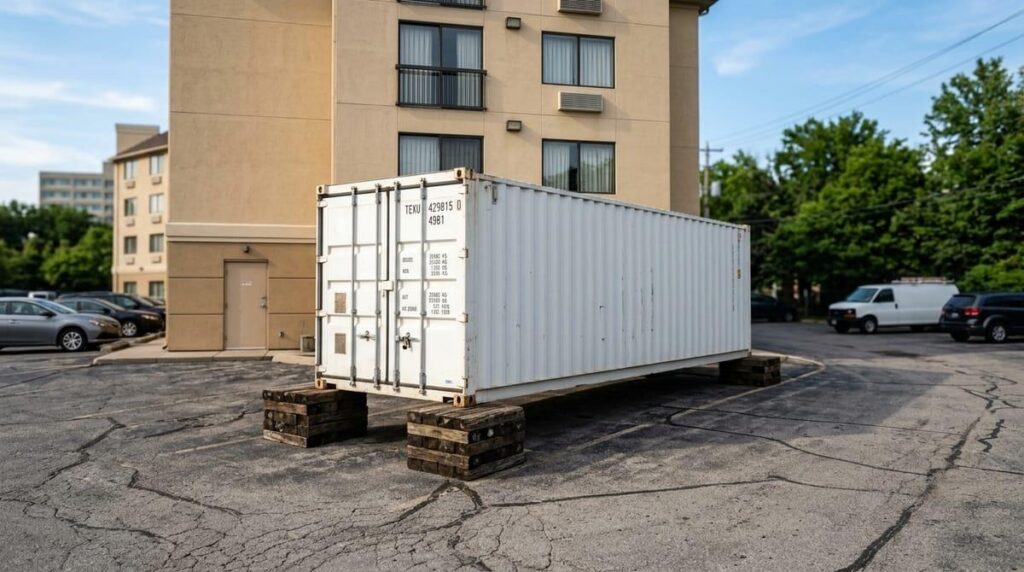
Asphalt and shipping containers have a complicated relationship in Florida summers. The corner castings (the four steel blocks at each bottom corner of the container) take the full weight of the unit and everything inside it. On hot asphalt, that point load can leave permanent indentations under a loaded 40-footer sitting through a 95-degree August.
Easy fixes. Heavy timber blocking (6×6 hardwood) under the four corners spreads the load. Small concrete pads at each corner are the permanent solution for long-term placement. Gravel base works for bare ground or grass. Steel load plates are available from us as an add-on for properties placing directly on asphalt. For containers sitting on grass or dirt, simple blocking is enough.
Keeping it discreet for guests
Custom paint matched to your building or brand colors is the biggest visual win. A 40-footer painted to match the exterior wall disappears against it in a way most property managers don’t expect. Position matters too. Containers tucked behind buildings, beside service drives, or near loading docks stay out of guest sightlines without any special treatment.
For semi-visible placements, lattice screens, vinyl fencing, or landscape buffers (palms, hibiscus hedges, dwarf bougainvillea) hide the unit while staying maintenance-light. Resort and wedding properties sometimes go further with full wood cladding or modular screening systems.
Local permits and zoning
Permit rules vary by city and county and usually depend on how long the container stays.
In most Florida and Georgia jurisdictions, containers used as temporary storage during an active building permit fall under construction-related rules and don’t need separate permitting. Containers placed for seasonal or permanent storage often have time limits (30, 60, or 90 days) before a separate permit or zoning review is required. Properties in resort communities, HOAs, or planned developments may have aesthetic standards layered on top.
Check with your local building or zoning office before delivery. A 10-minute phone call usually clears it up.
Securing valuable inventory in a hotel storage container
A locked steel container is already a serious deterrent compared to a soft-sided portable building or an outdoor staging area. A few upgrades take it further.
Lock hardware and access control
Standard cargo doors come with industrial vertical locking rods and a built-in handle housing that accepts a heavy-duty padlock. For properties storing high-value FF&E, custom electronics, or sensitive inventory, we can add a welded lockbox during modifications. The lockbox shrouds the padlock inside a steel housing, making it nearly impossible to attack with bolt cutters or grinders. For multi-unit setups, we can install matching locks across all containers so the engineering team carries one key.
Placement strategy adds another layer. Position the doors facing a building wall, a fence, or another container, which forces anyone trying to access the unit to do so in plain view.
Climate control for mattresses, linens, and soft goods
A standard steel container in Florida summer can hit interior temperatures of 120 to 140 degrees on a sunny afternoon. For tools, hardware, and finished case goods, that’s mostly fine. For mattresses, upholstery, linens, and anything fabric, it’s worth planning around.
Two cheap upgrades solve most of it. Roof vents installed during modifications create natural airflow. Solar-powered exhaust fans take it further at minimal cost. For premium soft-goods storage long-term, a wall-mount A/C unit with light insulation keeps the interior climate-controlled. A few standard practices help regardless of mods. Wrap mattresses in plastic, use sealed bins for linens, stack pallets under fabric goods to keep them off the floor, and avoid storing fabric directly against the steel walls in summer. Our full container modifications guide walks through every option, with pricing tiers and timelines for hotel-specific add-ons like A/C cutouts and ventilation.
Hurricane and weather considerations
Shipping containers handle wind better than almost any other on-site storage option. The corten steel walls and the structural design (originally built to stack nine high on a freighter in 25-foot seas) translate well to coastal weather. A loaded 40-foot container weighing 20,000 to 40,000 pounds typically rides out major storms without moving.
The bigger concerns during named storms are projectile damage from nearby debris, contents shifting if doors come open, and water intrusion through any modification that wasn’t properly sealed. Standard cargo doors latch securely, but it’s worth double-checking that the latch arms are fully seated before a storm. Properties in evacuation zones or with specific insurance requirements can add anchoring as an option, though it isn’t required for standard placement.
Renting vs buying hotel storage containers
Two options, depending on how long storage is needed. Buying outright makes sense for permanent or recurring storage. Straight rental makes sense when the project has a defined end date.
| Factor | Buy outright | Rent |
| Upfront cost | Full container price plus delivery | Delivery, pickup, and first month upfront |
| Approval process | None required | None required |
| Payment term | One-time payment | Month-to-month after minimum term |
| Minimum term | Not applicable | 6 months |
| Early buyout | Not applicable | Purchase at any point during the rental term |
| Ownership | Immediate | Does not transfer |
| Eligible grades | New One-Trip, Cargo Worthy, plus double-door, open-side, and refrigerated specialty units | New One-Trip, Cargo Worthy, plus double-door, open-side, and refrigerated specialty units |
Break-even for buying versus monthly off-site warehouse space usually lands in year two or three, after which the container becomes a property asset rather than an ongoing expense. Hotels with predictable annual storage cycles (pool gear, holiday decor, banquet inventory) almost always come out ahead buying.
Hotels running a defined renovation or brand-conversion project often find rental the cleaner fit. You pay for the time you need it, return it when the project wraps, and there’s no approval process between you and getting a container on-site. If the need turns out to be longer than expected, you can purchase the unit at any point during the rental term.
How to choose the right hotel storage container
Before requesting a quote, work through these questions. They cover the same information our sales team gathers from new hotel customers, and having the answers ready cuts the quote turnaround time significantly.
1. What’s the use case, and how long will the container stay? Renovation FF&E (six to eighteen months) leans rent-to-own. Permanent seasonal storage leans buy. Event-driven overflow can go either way.
2. What size do you actually need? Use the dimensions table above. Single-floor renovation phases and seasonal pool gear usually fit in a 20-foot. Full guest-room floors and large banquet operations need a 40-foot.
3. Where will the container sit on the property? Asphalt, concrete, gravel, grass, or dirt. The surface determines whether you need blocking, load plates, or a concrete pad. Also note any overhead clearance issues (low branches, awnings, power lines) for the delivery truck.
4. Will guests see it? If yes, plan for custom paint or screening. New One-Trip containers are the best option for guest-visible placements. If not, a Cargo Worthy container in its current condition works fine.
5. Do you need any modifications? Roll-up doors for fast banquet access, man doors for daily walk-in use, lockboxes for high-value FF&E, A/C and vents for soft goods, or custom paint to match brand colors. Modifications take 3 to 5 weeks, so build that into your project timeline.
6. When do you need it on-site? We run standard, expedited, and rush delivery options, with rush available in under a week for properties under deadline pressure. Order early when you can, since modifications add weeks to the timeline.
7. Will you ship cargo internationally from this container? If yes (some resort properties have this need for imports and exports), the container needs to be Cargo Worthy or New One-Trip, and we can issue a CSC certificate through our licensed surveyor.
Hotel storage container FAQ
Do hotels need a permit to place a storage container on the property?
Depends on your municipality. Containers placed during an active renovation usually fall under the existing building permit. Seasonal or long-term placements may require zoning approval. Check with your city or county building department before delivery, especially in resort communities or HOAs.
Will a shipping container damage our asphalt parking lot?
It can if you don’t plan the placement. Corner castings concentrate the unit’s weight on four small contact points, enough to leave indentations in hot Florida asphalt. Heavy timber blocking, concrete pads, gravel base, or steel load plates under the corners solve it.
How can we make a hotel storage container look less obvious to guests?
Custom paint to your brand colors is the biggest win. Position behind buildings, service drives, or loading docks when possible. For semi-visible placements, lattice screens, vinyl fencing, or landscape buffers (palms, hibiscus, bougainvillea) hide the unit without ongoing maintenance.
Can we safely store mattresses and linens in a steel container during a Florida summer?
Yes, with the right setup. Add roof vents during modifications for passive airflow, solar exhaust fans for active cooling, or a wall-mount A/C for full climate control. Wrap mattresses in plastic and use sealed bins for linens to handle humidity.
What happens to a shipping container during a hurricane?
Loaded 40-footers (20,000 to 40,000 pounds) typically ride out major storms without moving. Bigger risks are projectile damage, doors coming unlatched, or water intrusion through unsealed modifications. Double-check latch arms before a storm. Anchoring is available but not required for standard placement.
What modifications work best for hotel storage containers?
Roll-up doors for fast housekeeping access, man doors for daily walk-ins, custom paint for guest-visible placement, lockboxes for high-value FF&E, ventilation or wall-mount A/C for soft-goods storage. Modifications take 3 to 5 weeks depending on scope, handled in-house rather than outsourced.
Does E&S offer rental options for hotel storage containers?
Yes. E&S offers straight rental alongside outright purchase. Rental works well for projects with a defined end date. You pay delivery, pickup, and the first month upfront, with a six-month minimum term and no approval process. If your needs change and you want to keep the container, you can purchase it outright at any point during the rental term. Our sales team can walk you through which option fits your timeline before you commit to anything.
Get a hotel storage container quote from E&S Equipment
Hotels operate on tight timelines. New ownership wants the property refreshed before peak season. A renovation contractor pushes the start date forward. A wedding contract requires staging two months ahead.
Delivery to most Florida and Georgia properties runs one to two weeks from the time your order is confirmed. If your project is on a tighter timeline, ask about expedited options when you request a quote. All deliveries are handled by our CDL-licensed drivers using hydraulic tilt-bed trailers, with container depots in Miami, Jacksonville, and Savannah. Placement on your property is included.
A few things that separate us from the broker model most hotels run into online. Our owner is a licensed container surveyor, which means every container we sell can be inspected and certified to the standards used for international ocean shipping (CSC certificates available). All quotes come in writing, on company letterhead, with the container condition, modifications, and delivery details spelled out. And we back every container with a guarantee that it leaves our depots water tight and fully operational, regardless of grade.
Properties looking to buy outright, rent, or order custom modifications can request a quote directly through our online form. Our team will walk through your storage volume, project timeline, property access, and use case before recommending a size and configuration. No broker network. No third-party logistics. No surprise delivery charges from a depot you’ve never heard of.
Reach out for a quote on hotel storage containers for your Florida or Georgia property. We’ll match you with the right size, grade, and delivery window for your project.
0 Comments