
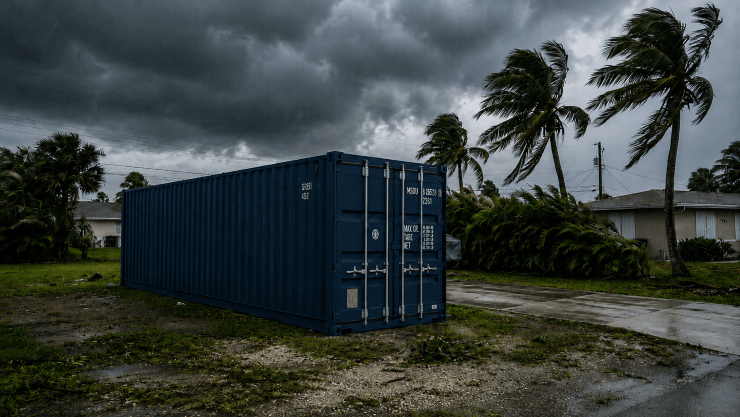
Florida and Georgia residents already know the drill. June rolls around, the weather services start naming systems, and everyone scrambles to refill the gas cans, board up the windows, and dig the generator out of the garage. The part most people skip until it’s too late? Figuring out where all that storm gear actually lives the other ten months of the year.
A shipping container handles that problem in a way a shed, a garage, or a rented storage unit just can’t. It sits on your property year-round, takes weather seriously, locks up tight, and doesn’t blow apart in a tropical storm. If you’re rethinking your hurricane prep this year, here’s why we keep getting calls about storm storage containers from May through October, and what most articles on this topic leave out.
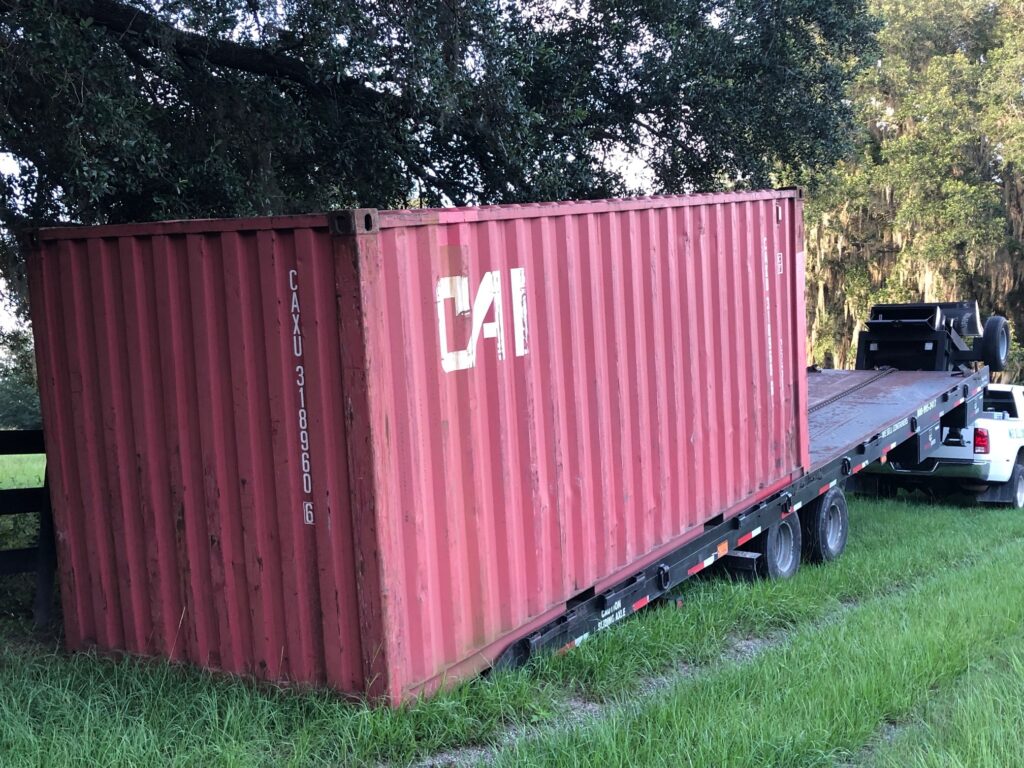
The case for a storm-ready container before June 1
Hurricane season officially runs June 1 through November 30, with peak activity from mid-August through October. By the time a storm has a name on it, your prep window is already closing. Gas stations run dry, hardware stores sell out of plywood and tarps, and delivery times stretch on everything from generators to bottled water.
A weather-resistant shipping container reverses that scramble. Once it’s on your property, your cargo container lives in one place all year. You’re not pulling tarps out from behind the lawnmower or driving to a self-storage unit on a Saturday because the cone of uncertainty just shifted.
The catch: storm-ready containers don’t show up overnight either. Delivery timeframes vary, though most orders arrive within one to two weeks. How quickly yours gets there depends largely on the season. Demand picks up fast once storm names start appearing on the news. If you wait until a storm forms in the Gulf to call us, we’ll do everything we can to help, but you’re a lot better off ordering in April or May.
What you’re actually up against
Hurricanes and tropical storms in this region throw four things at your property at once:
- Sustained high winds that turn loose objects into projectiles and tear weaker structures apart
- Heavy rain and flooding that ruins anything stored at ground level in a garage or shed
- Power outages that can last days, sometimes longer in rural parts of central Florida and south Georgia
- Supply chain disruption makes it hard to replace anything you’ve lost. Even after the storm passes, basic supplies and services can take two to four weeks to return to normal in heavily impacted areas. That’s the timeline most people underestimate. The damage from any one of those four factors is manageable. The combination is what eats up insurance deductibles and pushes business owners into weeks of downtime. Solid hurricane storage isn’t going to stop a hurricane, but it keeps the tools and supplies you need for recovery in one piece and within reach.
Worth noting: you don’t have to live on the coast to be at risk. Hurricane Ian in 2022 and Hurricane Milton in 2024 both made the point hard, with inland flooding tearing through central Florida communities that thought they were far enough from the water to ride it out. From Ocala to Lake City to Valdosta, the wind and rain don’t care how many miles you are from the beach.
Where garages, sheds, and rented units fall short
Most of what people use for emergency storage isn’t built for what hurricane season brings. Garages flood, especially on properties with any slope toward the structure. Plastic and wood sheds get lifted, twisted, or scattered across the yard. Interior closets work for a few bins of supplies, but they don’t hold a generator, a chainsaw, fuel cans, and an outdoor furniture set.
Off-site self-storage has its own problem during storm season: access. Right when you need your supplies most, the facility might be closed, blocked by flooding, or hard to reach safely. We’ve talked to plenty of customers who spent a Saturday in 2024 driving across town trying to grab gear out of a storage unit they couldn’t get into.
A shipping container parks the storage right where you need it.
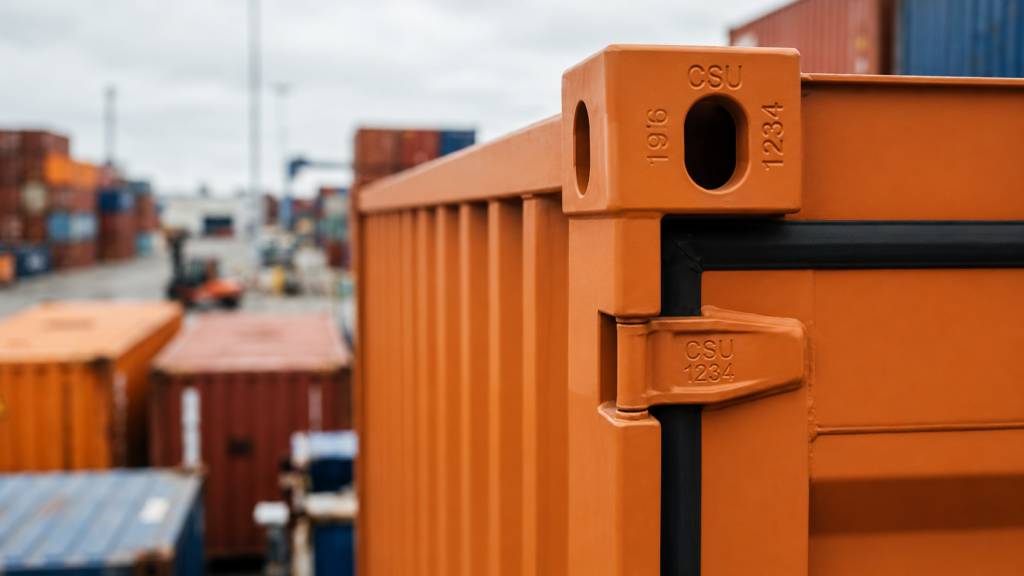
Why steel cargo containers hold up when other storage doesn’t
Shipping containers (also called CONEX containers, sea boxes, or cargo containers, depending on who you ask) were built for the North Atlantic in winter and Pacific crossings in typhoon season. The same construction that protects a load of electronics on a cargo ship is what protects your storm kit in your backyard.
A few things to know:
- Corrosion-resistant Corten steel. Shipping containers are made from a weathering steel alloy specifically engineered for weather exposure. It handles humidity, salt air, and prolonged rain better than aluminum sheds or wood construction.
- Sealed door gaskets. When the doors are closed and locked, the interior stays dry. We sell containers in two grades: New One-Trip and Cargo Worthy used, and both come 100% wind and water tight.
- Tight pest exclusion. Rodents, ants, and roaches have a hard time finding a way in. That matters when you’re storing food, fuel containers, or fabric items long-term.
- Weight. A 20-foot container weighs around 5,000 pounds empty. A 40-foot is closer to 8,500. They don’t move easily, which is the opposite of how a backyard shed behaves in 70 mph winds.
What a hurricane container won’t do (and why honest expectations matter)
Most of the articles you’ll find on this topic are happy to tell you that shipping containers are “hurricane proof” or that they “withstand Category 5 winds.” We’re going to be straight with you instead: no storage structure on the planet is genuinely hurricane proof, and the customers who get the most value out of their hurricane storage containers are the ones who go in with realistic expectations.
A few things to know:
- A direct hit from a major hurricane (Category 4 or 5) can move just about anything. Storm surge can lift cars, sheds, and yes, shipping containers. If you live in a coastal storm surge zone, no amount of steel changes the physics of moving water.
- Wind-driven debris can dent, scrape, and gouge container walls. Cosmetic damage doesn’t compromise the structure, but it happens.
- Falling trees do more damage during a Florida or Georgia storm than wind alone in most cases. A container isn’t invincible, but we’ve had customers tell us a tree came down directly on their unit and they were back to loading it the next day. The same storm took out their shed and carport. Steel holds differently than wood and aluminum when something heavy lands on it.
- Hurricane containers are designed for storage, not for shelter. Nobody should ride out a storm inside one. What steel cargo containers do consistently is keep your prep kit dry, secure, and on your property when you need it. That’s the realistic promise. Anyone telling you a steel box solves every storm scenario is selling, not informing.
Read our full take answering are shipping containers hurricane proof.
Where to place your hurricane storage container on your property
Placement is the part most homeowners don’t think about until the delivery truck is pulling in. A few practical guidelines:
- Pick high, well-drained ground. Avoid low spots where water pools after a heavy rain. If part of your property floods every year, that’s not the spot.
- Stay away from large trees. Especially older pines and oaks. Falling limbs and trunks are the most common source of container damage we hear about post-storm. Twenty feet of clearance from the canopy of a mature tree is a good rule.
- Think about door orientation. Position the cargo doors away from the direction of prevailing winds, which in most of Florida and Georgia means doors facing east or northeast. This keeps wind-driven rain and debris off the door seals.
- Mind the access path. Our delivery trucks need a clear 110-foot run on firm ground to drop the container. Soft sand, soggy lawns, and tight corners can stop a delivery before it starts.
- Consider future access. Once the container’s set, it’s set. Make sure you can pull a trailer up next to it, walk a generator into it, or load yard debris in after a storm without obstacles. You don’t need to anchor a shipping container for residential storage use. The weight does the work in normal storm conditions. If your local code requires anchoring or you want extra security, ask us during the quote process. We can talk you through what’s reasonable.
What to actually put in your hurricane prep container
You want this stuff to live in the container year-round, not get dragged out twice and then forgotten:
For homeowners
- Emergency kit basics: flashlights, batteries, first aid supplies, a hand-crank radio, water purification tablets
- A generator (kept clean, and ready) plus a few approved fuel cans
- Bottled water in bulk, plus shelf-stable food rotated yearly
- Tarps, rope, zip ties, a chainsaw, fuel-mixed gas for the saw
- Storm shutters or plywood pre-cut to your window dimensions, labeled
- Outdoor furniture, grills, and yard tools you’ll want to bring inside before the wind picks up
- Pet supplies: a week’s worth of food, carriers, leashes, medications, vaccination records
- Family-specific needs: prescription medications, baby formula and diapers, items for elderly family members
- A waterproof bin with critical documents (more on this below) For business owners
- Backup tools and inventory that would be costly to replace if the main building floods
- Fuel for company vehicles and generators, in compliant containers
- A copy of customer records, vendor contacts, and continuity plans on a waterproof drive
- Sandbags and tarps if your business is in a flood-prone area
- Anything you’d need to operate out of a truck or trailer for a week if your storefront is unusable Construction companies and landscapers we work with often keep an entire second set of small tools in their hurricane container so storm cleanup can start the day after a storm passes, while everyone else is still waiting on deliveries.
Don’t forget the document and insurance bin
A separate waterproof tote inside the container, labeled clearly, is one of the most useful things you can put in there. What goes in it:
- Insurance policy documents (homeowners, flood, business, auto)
- Photos and a written inventory of your home and major belongings, ideally taken within the last year and stored both physically and on a flash drive
- Property deeds, titles, and recent tax records
- Copies of driver’s licenses, passports, Social Security cards, and birth certificates
- A current list of medications and your family doctor’s contact information
- Emergency cash in small bills (ATMs and card readers often don’t work for days after a major storm) If you ever have to file an insurance claim or apply for FEMA assistance, having all of this organized and accessible saves weeks. After Hurricane Ian and Hurricane Milton, the SBA opened Economic Injury Disaster Loans for small businesses and Physical Disaster Loans for homeowners across affected counties. Having your records intact and on hand made every one of those applications faster.
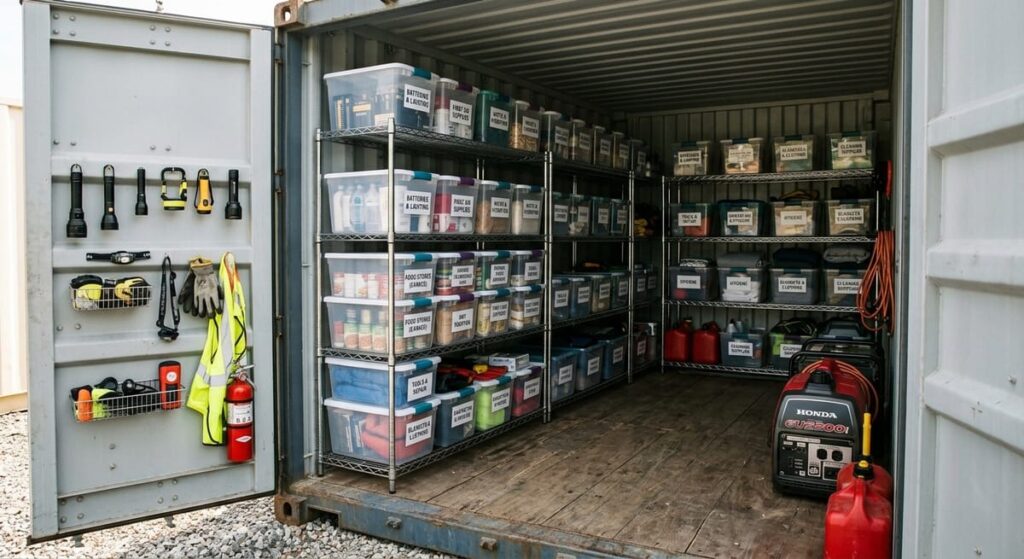
Setting up the inside so it actually works
A storage container with everything piled in one corner isn’t much better than a flooded garage. Some practical setup tips:
- Use metal or heavy-duty plastic shelving along both long walls. You’ll roughly double your usable space.
- Keep anything sensitive to humidity (electronics, paper, fabric) off the floor on pallets or wire shelves.
- Group supplies by category and label the bins. When the power’s been out for two days, you don’t want to be opening every tote looking for batteries.
- Put the items you’ll need first (flashlights, the radio, tarps) closest to the door.
- Rotate stock every spring. Replace expired batteries, swap out old food and water, top off the fuel cans, and test the generator. A 20-foot container holds enough for a family’s full prep plus a generator and outdoor gear. A 40-foot makes more sense if you’re combining household and business storage or you’ve got a big property to manage. High cube containers (an extra foot of vertical space) are worth considering if you’re planning to add shelving and want headroom for taller items.
Read our full guide on preparing for a hurricane.
How a hurricane shipping container compares to a rented self-storage unit
Both work for storage. Only one works well for hurricane prep.
| Feature | Self-storage unit | Shipping container |
| Location | Off-site, requires travel | On your property |
| Storm access | Limited or blocked during weather events | Walk out your back door |
| Structure | Varies, often not rated for severe weather | Built for trans-Atlantic cargo |
| Security | Facility’s lock standards | Your own padlock, or a lock box modification |
| Ongoing cost | Monthly rental indefinitely | One-time purchase or rent-to-own |
| Customization | None | Roll-up doors, vents, lighting prep, A/C, custom paint |
If you can’t drop the full purchase price in April but want a container on the property before the season starts, rent-to-own is worth a serious look. There’s no credit check. Terms run 12, 24, 36, or 48 months, and you put down the first and last month to get started. If you decide to buy it outright before the term ends, there’s a 33% early buyout discount. When you stack that against five years of self-storage payments, the container tends to win. Most customers find it pays for itself well before the rental fees would have caught up. For a lot of Florida and Georgia homeowners, it’s the most practical way to get storm-ready without waiting until they’ve saved the full amount.
Using your hurricane container after the storm
Most articles stop at pre-storm prep. The real value of an emergency storage container often shows up in the weeks and months after a major storm passes. A few of the ways our customers actually use their containers post-event:
Storing salvaged belongings during remediation. When a home floods, the dry-out and rebuild process can take months. Furniture, electronics, and personal items that survived have to live somewhere clean and dry while contractors gut the walls. A storm-ready container parked on the property keeps everything close, secure, and out of the way of the work.
Staging items for insurance claims. Adjusters often need to inspect damaged items in person before they pay out. A container gives you a place to keep damaged belongings sorted and accessible during the claim process, rather than tossing everything to the curb before the carrier sees it.
Locking up cleanup and rebuild tools. Contractors working on hurricane recovery jobs love having a commercial container on-site. Chainsaws, generators, tarps, and high-value tools that would otherwise need to be loaded into a truck every night stay locked up overnight, reducing theft risk and end-of-day overhead.
Construction company storage during the rebuild surge. After a major storm, demand for construction services in affected counties spikes for 12 to 18 months. Builders, roofers, and landscapers we work with use shipping containers to stage materials on residential and commercial job sites, especially when the surrounding infrastructure is still in recovery.
Municipal and emergency response staging. Government customers we serve through SAM.gov use containers for staging emergency supplies, equipment, and PPE before, during, and after activations. School districts use them for storing salvaged equipment when buildings need post-storm repairs.
Temporary business operations storage. If your storefront receives flooding or roof damage, a hurricane container becomes a way to keep inventory and equipment safe and dry while you wait on insurance, permits, and contractors. The SBA’s Economic Injury Disaster Loans can help cover operating costs during that gap, and your business records being intact and accessible (in that document bin we talked about earlier) keeps the application process moving.
The customers who get the most lifetime value out of a hurricane shipping container are usually the ones who use it for both halves of the storm season cycle.
Why local sellers matter more than ever during hurricane season
There’s a reason the broker model falls apart in storm season. A national outfit that listed an ad on Google can’t actually pick up a phone the week of a hurricane and tell you which depot has a 40-foot high cube ready to roll. They don’t own the trucks. They don’t know the routes. And once your deposit’s processed, they’re not the ones answering when the delivery doesn’t show.
We’re family-owned, we’ve been selling shipping containers in Florida and Georgia since 2010, and our owner Michael Bader spent 30+ years in the shipping and intermodal industry before opening E&S. He’s a licensed container surveyor, which means every container we sell has been inspected by someone who actually knows what cargo worthy means. We’ve delivered more than 11,000 containers to date, and the same team answers the phone now that answered it five years ago.
When a storm’s in the forecast, that continuity matters., “Better Containers, Professional Service,” isn’t a marketing line. It’s the standard we’ve held to for fifteen years.
Your hurricane season readiness checklist
Run through this list before June 1:
- Do you have one secure, weatherproof location on your property for all your storm supplies?
- Is your generator stored, fueled, and tested in the last 30 days?
- Are tarps, plywood, and tools accessible without driving anywhere?
- Have you accounted for outdoor furniture, grills, and yard equipment that would otherwise become projectiles?
- Have you assembled a waterproof bin of insurance documents, IDs, and property records?
- Are pet supplies and family-specific items (medications, baby supplies) stocked and rotated?
- For businesses: is there a continuity plan and a stash of operational supplies that doesn’t depend on your main building being intact?
- Have you reviewed your stock since last hurricane season? Batteries expire, water needs rotating, food goes stale. If most of those are “no,” it’s worth a conversation. We can usually scope out the right container size for your needs in a single phone call.
Get a quote on your hurricane shipping container before the season starts
The fastest way to get a written quote is the Request a Quote form. Want to talk through sizes, modifications, or rent-to-own options first? Call us at 800-995-2417, Monday through Friday from 9 a.m. to 6 p.m., or Saturday mornings until noon.
If you’re newer to shipping containers, our Shipping Containers 101 page covers the grades, sizes, and terminology. And if you’ve been quoted by an out-of-state company offering prices that seem too good, give our Avoid Container Scams guide a read before you put down any money.
Peace of mind in hurricane season starts with one thing: knowing your supplies are where you need them, when you need them.
Frequently Asked Questions
When should I order a hurricane shipping container for storm season?
Aim for March or April if you want a no-rush delivery window and time for modifications. By May, things tighten. Once a named storm is in the forecast, you’re working with whatever inventory is left at the nearest depot. Our standard delivery is 12 to 18 business days, expedited is 6 to 11, and rush is 3 to 5.
Can a shipping container survive a hurricane?
Shipping containers are built from Corten steel for trans-oceanic cargo, which makes them significantly more durable than wood or aluminum sheds. They’re not advertised as hurricane-proof, and no storage structure should be marketed that way, but steel cargo containers handle the wind, rain, and debris of typical Florida and Georgia storm seasons far better than the alternatives. Direct hits from major hurricanes can damage just about any structure, which is why placement and realistic expectations matter as much as the container itself.
What’s the best shipping container for hurricane preparation?
For most homeowners, a 20-foot Cargo Worthy used container hits the right balance of size, durability, and price. It holds a full hurricane prep kit (generator, fuel, water, food, tools, pet supplies, document bin, and outdoor gear) without being so big it dominates the yard. New One-Trip containers are the right call if you want factory-fresh condition or you’re planning custom paint and want a clean canvas. Both grades are 100% wind and water tight.
Where should I put a shipping container on my property?
Pick high, well-drained ground away from large trees. Position the doors away from prevailing winds (east or northeast facing in most of Florida and Georgia). Make sure our delivery truck has a clear 65-foot path on firm ground to drop the container. And think about future access for loading and unloading once it’s set.
Do I need to anchor my shipping container?
Anchoring isn’t required for residential storage use. A 20-foot container weighs roughly 5,000 pounds empty, and a 40-foot is closer to 8,000. They don’t shift in normal storm conditions. If your local code requires anchoring or you want extra security, ask us during the quote process.
What size hurricane container is best for my property?
A 20-foot container is enough for most households, including a generator, fuel, water, food, tools, pet supplies, document storage, and outdoor gear you want to move inside before a storm. A 40-foot makes sense if you’re storing for a business too, if you’ve got a large property, or if you want room for a workshop layout in addition to storage. A 40-foot high cube adds an extra foot of vertical space, which helps if you’re planning shelving.
Can I use a hurricane storage container after the storm too?
Yes, and most customers do. After a major storm, emergency storage containers commonly get used for storing salvaged belongings during remediation, staging items for insurance claims, locking up cleanup tools, and providing temporary business operations storage if a storefront is damaged. The post-storm use case is often where customers see the biggest return on the purchase.
Should I buy new or used for storm storage?
Both work for hurricane prep. New One-Trip shipping containers come in 5-year warranty condition and look factory-fresh. Cargo Worthy used containers are inspected, surveyed, and come with a 2-year warranty. They’re 100% wind and water tight and cost noticeably less. Most residential customers we work with go with Cargo Worthy used and put the savings toward modifications.
Can I rent-to-own a hurricane container before storm season?
Yes. Rent-to-own is one of our most popular options for homeowners and small businesses who want a shipping container on their property without paying the full price upfront. Ask about it when you request a quote.
Where do you deliver hurricane shipping containers?
Across Florida and into Georgia. Delivery cost is calculated from the closest depot to your address, with primary inventory in Miami, Jacksonville, and Savannah. We don’t deliver outside this service area.
What modifications make sense for a hurricane prep container?
The most useful ones are a roll-up door for easier access during loading and unloading, a lock box to secure the main doors, vents to manage interior humidity, and shelving inside. Wall A/C units make sense if you’re storing temperature-sensitive items. Container modifications typically take 3 to 5 weeks depending on scope, so build that into your timeline if you want them done before the season starts.
0 Comments