
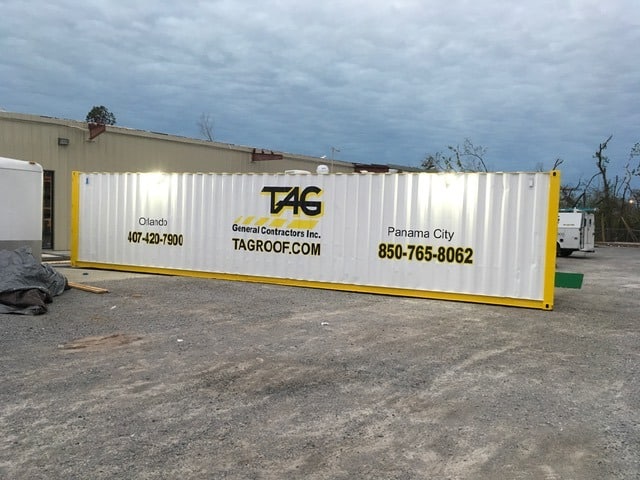
A Tampa contractor called us three weeks into a job. He had bought a 20ft container for a twelve-person crew to save a little up front. By week two, materials were stacked outside in the rain because nothing else fit, and he was paying for a second unit on a lot that barely had room for the first. The wrong size cost him more than the right one ever would have.
Picking a size looks simple until you are the one deciding. Too small and you are stacking gear outside or renting a second box. Too big and you are paying for air and giving up parking on a tight site. We have helped Florida and Georgia contractors get this call right since 2010, and it almost always comes down to four things: your crew, what you are storing, how it fits on your site, and the openings your equipment has to pass through.
Here is how to land on the right size the first time.
The sizes that work on a jobsite
We stock five sizes that see regular jobsite duty. Here is how they compare.
| Size | Footprint (ground) | Interior capacity | Best for |
|---|---|---|---|
| 10ft | ~80 sq ft (10 x 8) | ~560 cu ft | Tight lots, small crews, single-trade tools |
| 20ft | 160 sq ft (20 x 8) | 1,172 cu ft | The jobsite workhorse, crews up to 8 |
| 40ft standard | 320 sq ft (40 x 8) | 2,390 cu ft | Bigger crews, bulk materials, long stock |
| 40ft high cube | 320 sq ft (40 x 8) | 2,700 cu ft | Same footprint, extra foot of height |
| 45ft high cube | 360 sq ft (45 x 8) | ~3,040 cu ft | Maximum capacity in one unit |
The footprint is the ground it takes up. The capacity is what it holds inside. Those two numbers pull against each other on a tight site, and sorting out that tension is what the rest of this guide is for.
Start with your crew size
Crew size is the fastest way to a ballpark, because more hands means more tools, more materials moving through, and more people who need to grab something without waiting.
Small crews, 1 to 5 people. A 10ft or 20ft container is plenty. The 20ft (1,172 cubic feet on a 160 square foot footprint) handles tools and basic materials with room to move. Drop to a 10 foot container when the lot is tight or the crew is a single trade with just hand tools and a few power tools.
Medium crews, 6 to 12 people. One 40ft container is the sweet spot. At 2,390 cubic feet it roughly doubles the 20ft for about 50 percent more cost, and the extra length swallows long stock like lumber and conduit without cutting. Most contractors this size take one 40ft over two 20ft units for simpler delivery and one lock to manage.
Large crews, 13 to 20 people. Move up to a 40ft high cube for the extra foot of height, or run two containers. That vertical space lets you stack pallets four high instead of three, which matters more than people expect once materials pile up.
Extra-large crews, 20 plus. Plan on multiple 40ft units split by function. Big commercial jobs often run several containers, one for electrical, one for plumbing supplies, one for general materials, so crews are not digging through a single box to find anything
Then factor in what you are storing
Crew size gets you close, but what you store decides whether you sized it right, because materials eat space far faster than tools do.
A crew of eight with hand tools, power tools, and a couple of generators fits comfortably in a 20ft. Give that same crew a few weeks of drywall, lumber, and concrete bags to stage ahead of a bulk order, and you are into a 40ft in a hurry. Bulk material storage is usually what pushes a job up a size.
A rough rule: if you are mostly storing tools, size by crew. If you are staging materials in volume, size up one step from what the crew alone would call for. Long items change the math too, since anything over about 19 feet will not lie flat in a 20ft and needs the 40ft length.
One big container or several smaller ones
Once you cross into 40ft territory, the question becomes one big unit or a couple of smaller ones. The cubic feet can come out similar, so the decision is about logistics and access.
One 40ft usually wins on cost per cubic foot and gives you a single delivery fee and a single lock. Two 20ft units cost more to deliver and secure, but they let you split storage by trade or park them in two different spots on a spread-out site. On a large job where the electrical crew and the framing crew work opposite ends of the lot, two boxes save a lot of walking. On a tight residential lot, one unit is almost always the better call.
Check the openings before you buy
Capacity means nothing if your equipment will not fit through the door. Standard cargo doors give you roughly 7 feet 8 inches of width and 7 feet 6 inches of height. High cube units run taller.
An Atlanta contractor once ordered a 40ft for a piece of equipment that measured 8 feet wide. It never went inside. It sat under a tarp for six months because nobody checked the door opening against the load. Measure your largest piece against the door before you order, and if it is close, talk to us about a unit with wider access or a set of double or open-side doors.
Standard height or high cube
Height is the size decision people forget. A standard container gives you about 7 feet 10 inches inside. A high cube adds a foot, to roughly 8 feet 10 inches.
That extra foot is worth it in two cases: when you are stacking palletized materials and want another layer, or when you are storing tall equipment that would otherwise scrape the ceiling. If you are only storing tools and boxes, standard height saves a little money and does the job.
Will it fit your site
The last check is the ground. Every size needs level, firm space plus room for the delivery truck to line up. A 20ft needs about 160 square feet of footprint, a 40ft about 320, and the truck needs a straight approach and overhead clearance to slide it off the tilt-bed.
On a tight residential lot, that access is often the real limit, not the storage need. It is why the 10ft exists: when a 20ft will not physically fit or leaves no parking, the 10ft gets secure storage on site without eating the whole yard. For the full rundown on delivery clearances and site prep, see our delivery guide.
The one-size-up rule
When your math fills a container past about 90 percent, go one size larger. A container packed wall to wall means you are climbing over the front stack to reach anything in the back, and you have no room for the materials that show up mid-job. The jump from a 20ft to a 40ft, or from standard to high cube, is a small monthly difference next to the cost of a second emergency unit or gear left outside. Size for the busiest week of the project, not the first one.
Quick size cheat sheet
| Your situation | Start here |
|---|---|
| Single trade, hand and power tools, tight lot | 10ft |
| Crew up to 8, tools and light materials | 20ft |
| Crew of 6 to 12, or staging bulk materials | 40ft standard |
| Stacking pallets or storing tall equipment | 40ft high cube |
| Maximum capacity in one unit | 45ft high cube |
| Large crew, split by trade or spread-out site | Two 20ft or multiple 40ft |
Use it as a starting point, then adjust up if you are heavy on materials or long stock.
Get the right size on the ground
Still not sure? Tell us your crew size, what you are storing, and your site, and we will point you to the size that fits without overpaying for space you will not use. For the bigger picture on uses, modifications, and placement, see our complete guide to construction storage containers, and for how condition affects price, read up on container grades and conditions. Contractors who want a unit on site without the upfront cost can also rent-to-own with no credit check.
Call E&S Equipment at (904) 703-0507 or request a quote, and we will get the right size delivered across Florida and Georgia. Better containers and professional service since 2010
FAQ
What size container do I need for a 10-person crew?
One 40ft container fits most crews of 6 to 12, holding tools plus staged materials with room to work. If you are storing bulk materials on top of tools, look at a 40ft high cube or a second unit.
Is one 40ft better than two 20ft containers?
Usually, yes. One 40ft costs less per cubic foot, ships in one delivery, and needs one lock. Two 20ft units make sense only when you want to split storage by trade or place containers in two spots on a large site.
Will a 20ft container fit in a residential driveway?
Often, but not always. A 20ft needs about 160 square feet of level ground plus a straight approach for the truck and overhead clearance. On tight lots a 10ft is the safer fit. Send us photos of the site and we will confirm before delivery.
Can I stack containers to save ground space?
Yes. Containers stack safely two high on a jobsite with no special reinforcement, which is one way to add capacity when the footprint is limited. Stacking needs the right equipment to place the top unit, so plan it with us ahead of delivery.
0 Comments