

If you’re comparing a 20ft vs 40ft shipping container, you’re making a decision that involves real money and real logistics. This guide covers interior dimensions, storage capacity, which size fits which buyer, condition grades, and what delivery actually requires.
E&S Equipment Sales is not a broker. We own our inventory, inspect every container with a licensed surveyor, and deliver across Florida and Georgia with our own CDL-licensed drivers. Since 2010, we’ve put more than 13,000 intermodal containers into service.
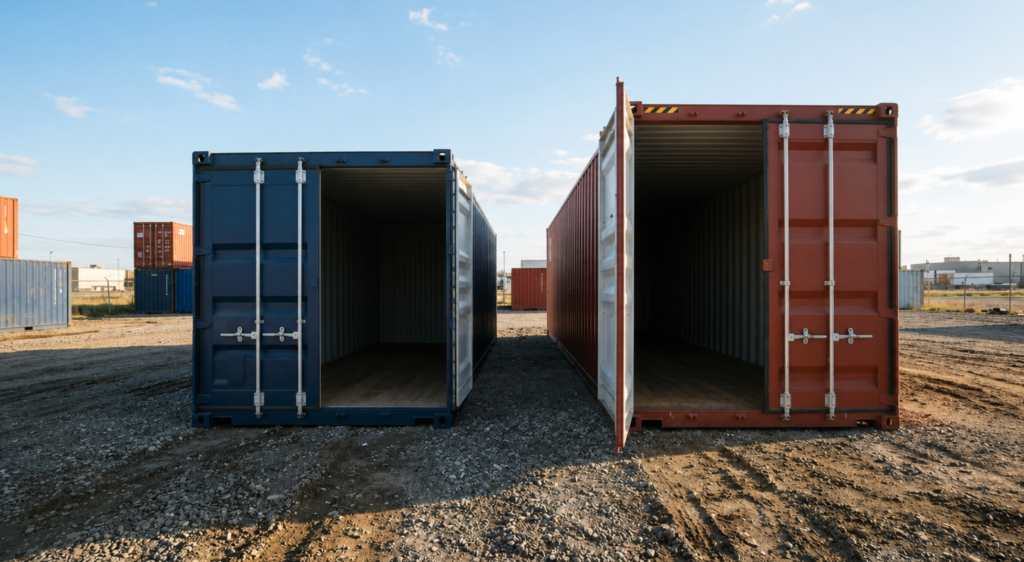
20ft vs 40ft Shipping Container Dimensions and Specifications
| Specification | 20ft Standard | 20ft High Cube | 40ft Standard | 40ft High Cube |
| Interior length | 19’4″ | 19’4″ | 39’5″ | 39’5″ |
| Interior width | 7’8″ | 7’8″ | 7’8″ | 7’8″ |
| Interior height | 7’10” | 8’10” | 7’10” | 8’10” |
| Door opening (W x H) | 7’8″ x 7’5″ | 7’8″ x 8’5″ | 7’8″ x 7’5″ | 7’8″ x 8’5″ |
| Interior square footage | ~160 sq ft | ~160 sq ft | ~320 sq ft | ~344 sq ft |
| Interior cubic volume | ~1,170 cu ft | ~1,320 cu ft | ~2,390 cu ft | ~2,694 cu ft |
| Payload capacity | ~47,900 lbs | ~47,900 lbs | ~59,040 lbs | ~58,600 lbs |
| Tare weight | ~4,850 lbs | ~5,070 lbs | ~8,160 lbs | ~8,775 lbs |
40ft shipping container dimensions give you roughly the floor space of a two-car garage. A 20ft TEU is closer to a one-car garage. The High Cube adds a full foot of interior height, which matters when storing tall equipment, stacking pallets high, or planning a workshop conversion. Standard door openings are 7’8″ wide on both sizes.
E&S carries both sizes in Standard and High Cube, in New 1-Trip and Cargo Worthy condition.

Which Shipping Container Size Do You Actually Need?
Farmers and Agricultural Buyers
A 20ft container holds around 8-10 round bales or 100+ square bales. A 40ft doubles that capacity. For feed, seed, fertilizer, or equipment storage through winter, the 40ft is the smarter long-term buy.
Property access matters more on farms than container size alone. A 40ft requires about 100 feet or more of clear run; a 20ft needs closer to 60-70 feet. If your drive won’t fit a 40ft, that’s your practical answer. We’ll assess your access before scheduling anything.
Check out 12 Practical Agricultural Storage Container Uses That Cut Farm Costs
Construction and Job Site Managers
The 20ft wins on portability. When you’re moving between sites every few months, it’s easier to relocate and keeps delivery costs lower. For longer-term projects where you need to secure significant equipment or materials, a 40ft pays for itself in reduced theft and better organization.
If you need a container without the full upfront cost, our rent-to-own program is worth a look. No credit checks, 12-48 month terms.
Business, Commercial, and Government Buyers
For document storage, inventory, or on-site equipment, the 40ft is almost always the right call. The cost-per-square-foot advantage is real at scale, and one 40ft unit is easier to manage than two 20ft units side by side.
E&S Equipment Sales is registered on SAM.gov for federal contracts and has served municipalities, auto dealers, HOAs, and agricultural operations across Florida and Georgia. Commercial buyers: call us directly rather than filling out a form.
International and Caribbean Freight Shippers
If you’re shipping goods overseas, your container must be CSC certified (Container Safety Convention certification). Not all containers qualify, and not all suppliers can issue the paperwork.
E&S Equipment is a licensed container surveyor who inspects and issues CSC certificates in-house.
Only New 1-Trip and Cargo Worthy containers can qualify. Wind and Water Tight containers can’t be certified for ocean shipping, regardless of what a seller tells you.
What Container Size is Right for You?
Choosing between a 20ft and a 40ft shipping container ultimately comes down to your available footprint, storage volume needs, and long-term goals. If portability and tight access are your main constraints, the 20ft container is your best bet. However, if you have the clearance and need maximum storage capacity, or are planning a larger modification project, a 40ft unit offers unmatched cost-per-square-foot value.
Whichever size you choose, working with a reliable supplier makes all the difference when buying a shipping container. At E&S Equipment Sales, we skip the middleman. By owning our inventory, employing our own CDL-licensed drivers, and having a licensed surveyor in-house, we ensure you get exactly what you pay for—delivered safely and professionally to your site.
Ready to lock in your container? Request a written quote or call us directly at (800) 995-2417 to discuss your project and schedule your delivery.
Frequently Asked Questions
How much more does a 40ft container cost compared to a 20ft?
A 40ft costs more than a comparable 20ft in the same condition grade, but delivers roughly double the interior cubic volume, so the cost-per-square-foot often favors the larger unit. For current pricing, request a quote; prices move with depot availability and market conditions.
Will a delivery truck fit on my property?
A 20ft delivery requires about 60-70 feet of clear, relatively level driveway. A 40ft requires 100 feet or more. Our CDL-licensed drivers use specialized hydraulic tilt-bed equipment and will walk through your site requirements before scheduling.
Can I use a Wind and Water Tight container to ship goods internationally?
No. WWT containers are storage-grade only and can’t be CSC-certified for ocean transport. Only New 1-Trip and Cargo Worthy containers qualify. E&S Equipment Sales’ owner is a licensed container surveyor who issues CSC certificates in-house.
What’s the real difference between Cargo Worthy and Wind and Water Tight?
Both grades seal out weather, but Cargo Worthy containers have been inspected and certified to meet structural standards required for ocean shipping. WWT containers keep rain out but haven’t been certified for those structural demands. For international shipping or long-term investment value, Cargo Worthy is the right grade.
Does container size affect which modifications I can add?
Both 20ft and 40ft sizes support the same modification types. The difference shows up when planning a workspace conversion — a 40ft gives more interior flexibility for partition walls and multiple access points. Tell us your plans before you order.
How long does the process take from quote to delivery?
Standard delivery runs 12-18 business days. Expedited options are available at 6-11 business days, or 3-5 business days for rush orders. If modifications are included, add 3-5 weeks before delivery starts.
Is a High Cube worth the upgrade for general storage?
For most ground-level storage needs, a standard-height container is fine. The High Cube earns its place when storing tall equipment, stacking pallets more than two units high, or planning a workshop conversion where ceiling clearance matters. The door opening is also a full foot taller, which helps when loading with equipment.
0 Comments