

Looking for shipping container modifications but worried about quality, timelines, or hidden broker markups? The container modification market has a problem: brokers who outsource work to unknown fabricators, creating uncertainty around pricing, quality control, and delivery schedules. At E&S Equipment Sales, we modify containers in-house with certified fabricators and licensed container surveyor oversight. Since 2010, we’ve completed over 2,400 custom shipping container modifications across Georgia, Florida, and Eastern Alabama. Every project is built at our facility under direct quality control.
This guide covers everything you need to know about container modification services: standard installations like roll-up doors and windows to complex custom builds for agricultural, construction, and government applications. We explain what’s possible, provide transparent pricing guidance, and help you choose the right container grade for your modification project.
Table of Contents
Container Modification Services and Pricing
The following sections detail every major modification type we offer for custom shipping container conversions, with starting prices. Final costs depend on container condition, modification complexity, and delivery location.
Doors and Access Modifications for Modified Shipping Containers
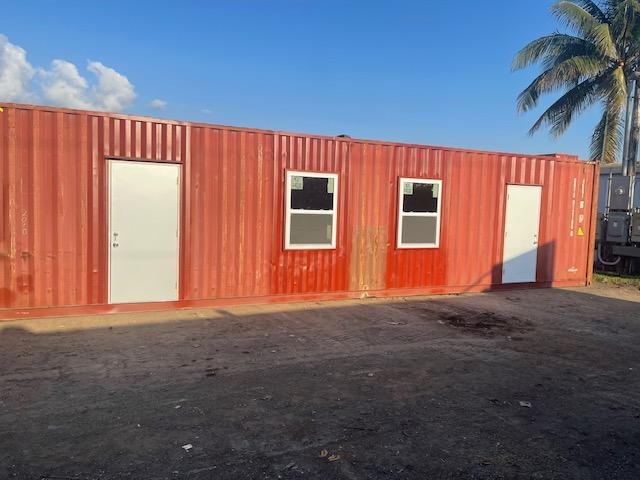
Personnel Doors (Man Doors)
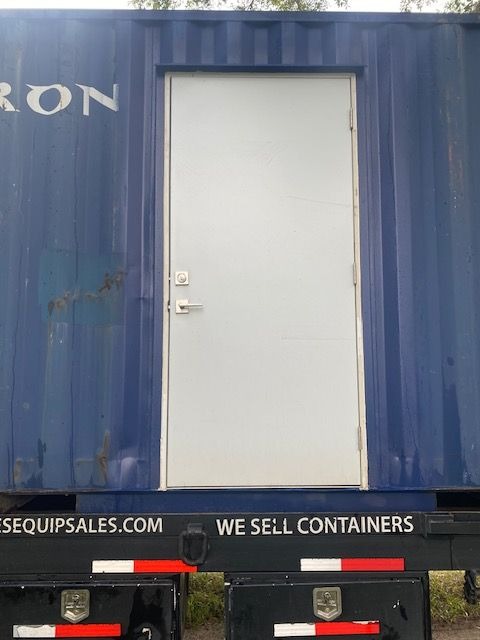
A personnel door provides walk-in access without opening full cargo doors. Essential for containers used as workshops, offices, or storage areas requiring frequent access.
We install commercial-grade steel doors with weather stripping, locksets, and reinforced framing. The door frame is welded to the container’s structural corrugations, then sealed with marine-grade sealant to prevent leaks. Standard size is 36″ x 80″, though custom sizing is available.
Installation requires precise cutting of corrugated steel wall, installation of structural steel frame that maintains load-bearing capacity, mounting door unit with commercial-grade hinges and hardware, and comprehensive weatherproofing with interior and exterior sealant application. Each personnel door undergoes pressure testing to verify complete weather-tight integrity before delivery.
Roll-Up Doors
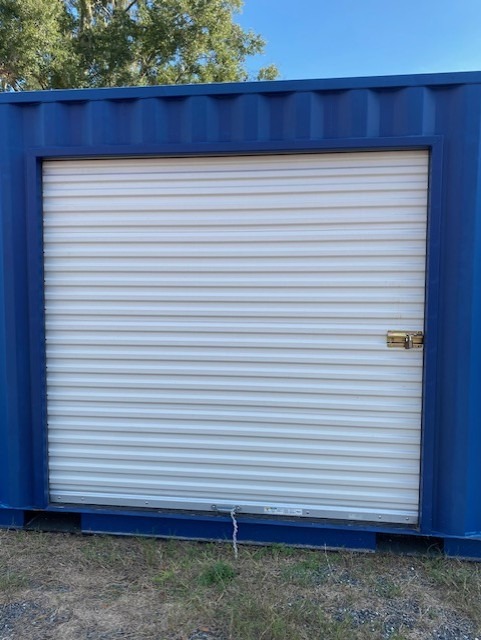
Roll-up doors transform container access for drive-in applications. Popular for equipment storage, agricultural storage (tractors, hay balers), and construction sites requiring forklift access.
We cut out the entire end wall (except corner posts and top rail, which maintain structural integrity), install steel roll-up door tracks, and weld in reinforcement framing. Roll-up mechanisms include locking bars and weather seals.
Removing an end wall eliminates substantial load-bearing surface area, requiring heavy-gauge steel tube reinforcement around the entire perimeter. These reinforcements are welded to corner posts and top rail, redistributing loads while providing secure mounting points for the door track system. Our surveyor calculates load capacities for each installation to make sure the modified container maintains acceptable structural ratings for ground-level use.
Double Door and Swing Door Conversions
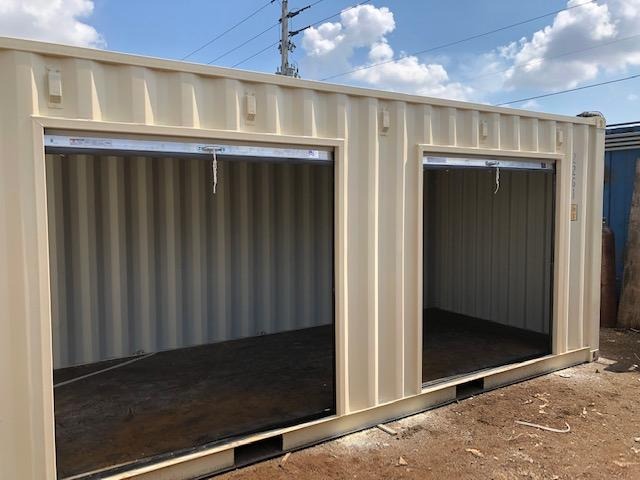
Standard containers have cargo doors at one end only. For drive-through access or simultaneous loading from both ends, we install cargo doors at the opposite end. These containers are manufactured with double doors in China, and we stock them regularly for customers needing this configuration.
Climate Control Modifications for Container Workspace Conversions
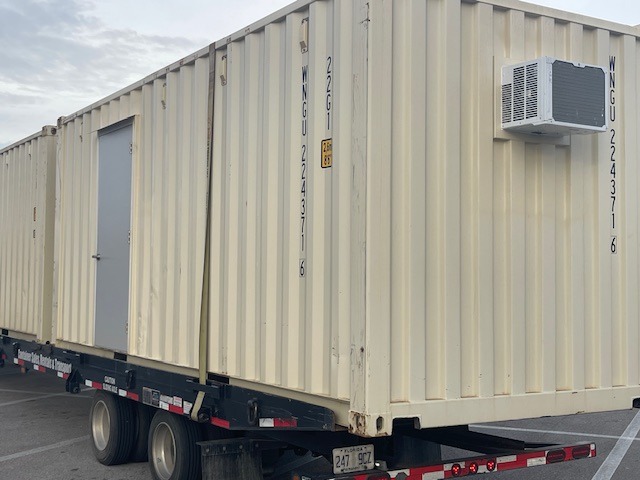
Wall-Mounted A/C Unit Cutouts
For year-round storage or workspace use, climate control is essential. We cut precise openings for wall-mounted mini-split A/C units, reinforce the opening with steel framing, and seal all penetrations.
most residential mini-split systems with 3-inch refrigerant line sets. We position cutouts based on your specific unit requirements, usually on the side wall opposite cargo doors for optimal airflow distribution. The cutout includes a steel sleeve extending through both interior and exterior walls, providing a weather-tight conduit for refrigerant lines and electrical connections.
You’ll need a licensed HVAC contractor to install the actual unit and run refrigerant lines, but we provide structural penetration and weatherproofing. Our cutouts are engineered to support the weight of standard residential mini-split outdoor units, which range from 40 to 80 pounds.
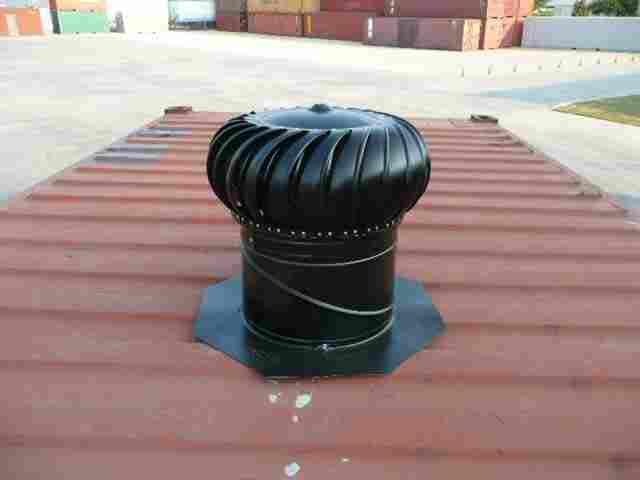
Ventilation Systems
Passive ventilation prevents moisture buildup and temperature extremes. We install roof-mounted turbine vents (whirlybirds) or louvered wall vents depending on your application.
Agricultural customers need ventilation for hay storage to prevent mold. Container workshop conversions benefit from passive and powered ventilation to manage heat and fumes. For hay storage applications, we recommend one roof vent per 20 linear feet of container length, positioned to create natural convection currents that draw moist air upward and out.
Roof vent installations require careful waterproofing. We cut precise openings sized to the vent base, install a raised mounting flange that prevents water pooling, and apply multiple layers of marine-grade sealant combined with rubber gasket seals. Each roof penetration is tested with high-pressure water spray to verify leak-free performance.
Insulation Packages
Insulation transforms a steel box into a comfortable workspace. We apply closed-cell spray foam insulation to walls, ceiling, and doors (floor insulation available but uncommon due to load-bearing concerns).
Insulation thickness varies: R-13 for basic temperature control, R-21 for climate-controlled environments. Closed-cell spray foam provides both thermal insulation and moisture barrier properties, which is crucial for preventing condensation inside the container’s steel walls.
For office and workshop applications, we recommend R-21 insulation combined with an HVAC system for year-round comfort. In summer months across Georgia and Florida, uninsulated containers can reach internal temperatures exceeding 120°F. Insulation keeps interior temperatures within 10-15 degrees of ambient with minimal climate control.
Windows and Natural Light for Container Office Conversions
Standard Windows
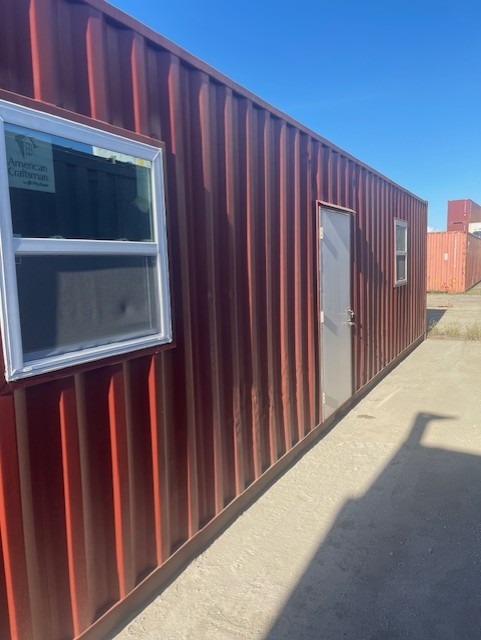
Natural light dramatically improves container offices and workshops. We install commercial-grade slider windows with insulated glass, weather seals, and lockable latches.
Standard sizes are 36″ x 24″ or 48″ x 36″, though custom sizing is available. Each window opening is framed with steel reinforcement welded to the container’s vertical corrugations. The window unit sits in this frame with compression mounting that creates a weather-tight seal. We use dual-pane insulated glass on all window installations to prevent condensation and provide thermal efficiency.
Window placement should consider sunlight orientation. South-facing windows provide maximum natural light but also maximum heat gain. East-facing windows offer morning light with less heat burden, while north-facing windows provide consistent diffused light without direct sun exposure.
Skylight Installations
Skylights provide overhead natural light without sacrificing wall space. We cut rectangular or square openings in the roof, install steel framing, and mount polycarbonate or acrylic skylight domes with rubber gasket seals.
Roof penetrations require extra attention to waterproofing. Our surveyor inspects every skylight installation to verify leak-free performance. Skylight domes are impact-resistant and UV-stabilized to prevent yellowing or brittleness. The dome design includes built-in water channeling that directs rain away from the seal.
Electrical Modifications for Container Customization
Panel Cutouts and Access
Electrical panel cutouts allow licensed electricians to install breaker boxes inside the container while maintaining weatherproof access from outside. We cut the opening, install a steel door or panel cover, and weatherproof all edges.
Standard electrical panels require access openings sized to accommodate 100-amp or 200-amp breaker boxes. We position these cutouts on the container exterior wall at standard heights (4-5 feet from ground level) for code compliance and convenient access. The cutout includes a hinged steel door with weatherproof gasket seal.
Electrical work must be completed by licensed electricians per local codes. At E&S, we provide the structural access, and you arrange the electrical installation.
Lighting and Outlet Cutouts
For exterior floodlights or interior overhead fixtures, we cut precise openings and install mounting hardware, including conduit pass-throughs for wiring.
Exterior lighting cutouts include weatherproof junction box mounting plates, while interior cutouts provide structural mounting points for fixture hardware. We install cutouts for LED shop lights in workshop conversions, positioning them at 8-10 foot intervals along the container ceiling for uniform illumination.
Exterior Container Modification Solutions
Custom Paint and Coatings
Containers arrive in various colors. One-trip containers are white or light gray, while cargo worthy used containers may be blue, red, green, or other colors. Custom paint allows you to match your branding, property aesthetics, or local requirements.
We use commercial-grade exterior paint designed for steel surfaces. Preparation includes rust removal, primer application, and two-coat coverage.
The paint process begins with power washing to remove contaminants, wire brushing or grinding to address surface rust, and solvent cleaning for proper adhesion. We apply rust-inhibiting primer formulated for marine steel, followed by two coats of high-durability exterior paint. For coastal applications in Florida, we recommend additional protective coatings to resist salt air corrosion.
To keep your custom-painted container looking new and to prevent dirt buildup from degrading the finish over time, we recommend an annual cleaning from a local power washing company.
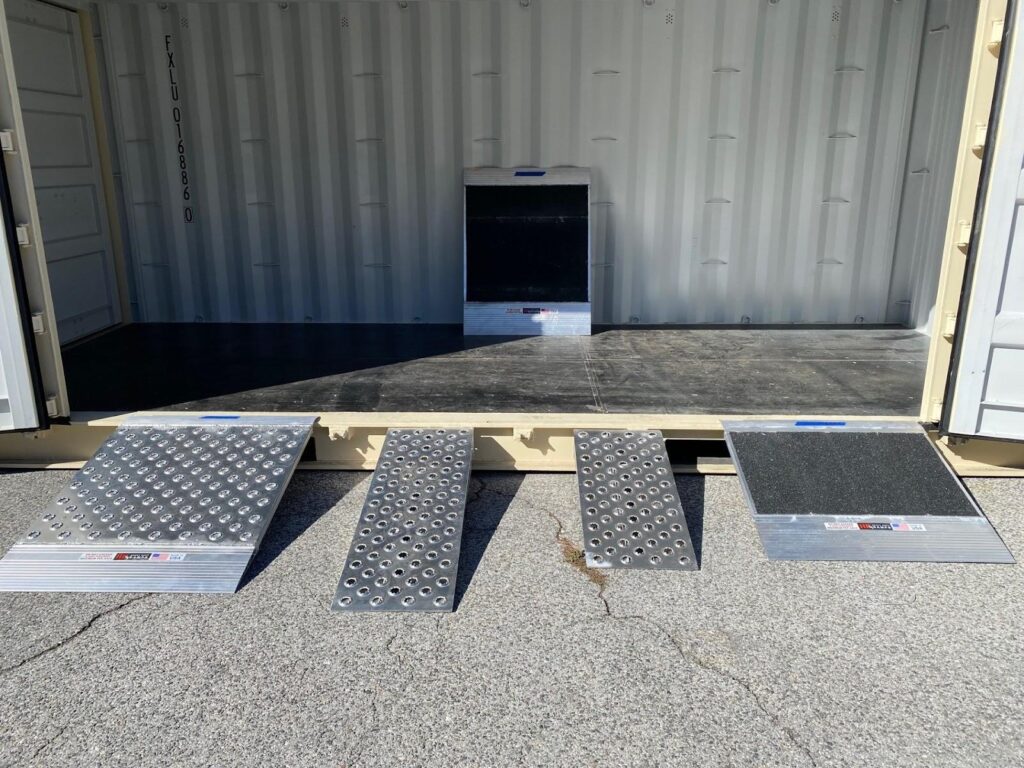
Container Ramps
Steel ramps enable wheeled equipment access for mowers, ATVs, pallet jacks, or wheelbarrows. We fabricate ramps from steel plates with non-slip surface texture, attach them to the container threshold, and include removable legs for ground support.
Standard ramps are 36″ wide and accommodate 3-4 feet of elevation change. Ramp angle is engineered for safe equipment operation, usually 15-20 degrees for powered equipment. The non-slip surface is created through either expanded metal grating or raised diamond plate patterns that provide traction in wet conditions.
Lock Boxes and Security Enhancements
Lock boxes protect padlocks from bolt cutters and weather exposure. We weld steel enclosures around standard cargo door locking bars, creating secure housing for your padlock.
Lock boxes are fabricated from a heavy-gauge steel plate that resists cutting and prying. The enclosure design prevents access to the padlock shackle, eliminating the most common theft method.
Additional security enhancements include reinforced locking bar assemblies that distribute force across multiple points, making door forcing significantly more difficult.
Shelving and Interior Storage Container Modifications
Wall-Mounted Shelving Systems
Industrial-strength shelving turns containers into organized storage or workshop space. We install steel brackets welded to wall corrugations, with lumber or steel shelves spanning between supports.
Shelving capacity depends on bracket spacing and shelf material, but most installations support several hundred pounds per shelf. The key to successful container shelving is mounting brackets to the vertical corrugations, which provide the strongest attachment points.
Partition Walls
For containers serving dual purposes (office plus storage, for example), we install interior partition walls using steel studs and panel sheathing. Walls can include doors for access between sections.
Partition walls are constructed with steel stud framing welded or mechanically fastened to the container floor, walls, and ceiling. We cover the framing with plywood, OSB, or steel panel sheathing depending on your application.
Workbench Installations
Workshop conversions benefit from built-in workbenches. We weld steel framing to the container walls and install work surfaces at comfortable heights. Includes tool storage underneath and electrical access for power tools.
Standard workbench height is 36 inches for general purposes, though we can adjust to specific ergonomic requirements. Work surfaces can be lumber, plywood, or butcher block depending on intended use.
Popular Container Modification Packages
Rather than selecting individual modifications, many customers choose pre-configured container conversion packages:
| Package Type | Included Features | Starting Price | Best For |
| Workshop | Personnel door, 2 windows, electrical panel cutout, ventilation, optional custom paint | Contact for pricing | Woodworking, mechanical repairs, equipment maintenance |
| Climate-Controlled Storage | Insulation (walls/ceiling/doors), HVAC cutout, personnel door, ventilation, electrical cutouts | Contact for pricing | Temperature-sensitive equipment, document archives, inventory storage |
| Agricultural Storage | Roll-up door, enhanced ventilation, rodent-proofing, custom paint, optional shelving | Contact for pricing | Tractors, hay/feed storage, equipment protection |
| Job Site Office | Personnel door, multiple windows, HVAC cutout, electrical panel/outlets, insulation, custom paint | Contact for pricing | Project management, plan review, crew briefings |
Our Five-Step Container Modification Process
Step 1: Consultation and Quote (1-2 Days)
Submit your modification requirements through our quote form or discuss them with our modification specialist by phone. We ask questions about intended use, property constraints, and any local requirements (permits, HOA restrictions).
Within 24 hours, you receive a detailed written quote on company letterhead, outlining each modification, timeline, and total cost including delivery. The quote breaks down individual modification costs, container costs, delivery charges, and any optional upgrades.
Step 2: Design and Engineering (1-2 Days)
For complex modifications or projects requiring permit approval, we create detailed specifications and structural calculations. Our licensed container surveyor reviews all designs to verify modifications, maintain container integrity and meet safety standards.
If you need engineered drawings for permit applications, we provide stamped documentation. These drawings include load calculations, material specifications, and installation methods that satisfy most municipal building departments.
Step 3: Fabrication (3-7 Days)
Your container enters our modification bay where certified fabricators complete the work. Each modification is done in sequence: cutting, framing, installation, welding, and sealing.
Our surveyor conducts progress inspections throughout fabrication. For multi-modification projects, we sequence work to prevent interference between installations.
Step 4: Quality Inspection (1 Day)
Every completed modification undergoes final inspection including leak testing on all penetrations (high-pressure water spray), weather seal verification on doors, windows, and roof openings, structural integrity assessment, and final surveyor sign-off.
Leak testing involves sustained high-pressure water spray on all modified areas while inspectors examine interior surfaces for any moisture intrusion. Only after passing inspection does the container move to our delivery yard.
Step 5: Delivery (7-12 Days Standard)
Our CDL-licensed drivers transport your modified container on specialized trailers. Delivery includes precise placement at your specified location.
You inspect the container upon delivery. Any concerns are addressed immediately or documented for follow-up. We encourage customers to inspect all modifications: test doors, check seals, verify electrical cutouts match your equipment.
Industry-Specific Container Modification Options
Agricultural and Farms
Hay and Feed Storage
Proper hay storage requires ventilation to prevent mold while keeping moisture out. We install multiple roof vents for continuous airflow, along with roll-up doors at both ends for drive-through access.
Hay storage containers benefit from enhanced ventilation beyond standard configurations. We recommend one roof vent per 10-12 feet of container length, creating strong convection currents that draw moisture upward and out.
For feed storage, ventilation is paired with rodent-proofing treatments that seal gaps and add deterrent materials around openings. We seal the junction between floor and walls, install door sweeps on personnel doors, and add wire mesh screens over ventilation openings.
Equipment and Chemical Storage
Agricultural equipment needs protection from sun and rain but requires wide access. Roll-up door installations allow tractors, balers, and combines to drive directly in.
Equipment storage benefits from double-door configurations (doors at both ends), creating drive-through capability. This eliminates the need to back equipment out.
Chemical storage requires lockable security and benefits from interior shelving for organized storage. Lock boxes prevent unauthorized access, and ventilation systems manage fumes from volatile materials.
Farm Workshop Container Conversions
Converting a container into a farm workshop involves windows for natural light, personnel door for access, electrical cutouts for your electrician to wire power and lighting, and ventilation to manage heat and fumes.
Farm workshops serve as field repair stations, reducing downtime by enabling on-site equipment repairs rather than hauling machinery to town. The mobile nature of containers means workshops can be relocated between fields or farm properties as operational needs change.
Construction Site and Jobsite Container Modifications
Mobile Office Containers
Site offices require climate control, natural light, and professional appearance. Our job site office package includes a personnel door with commercial-grade entry hardware, multiple windows for visibility and natural light, HVAC cutout for mini-split A/C system, insulation for year-round comfort, electrical panel and outlet cutouts, and custom paint with company branding.
Job site offices include communication infrastructure cutouts: conduit runs for internet/phone lines, mounting points for security cameras, and weatherproof cable entry points.
Secure Tool and Equipment Storage
Modified containers with reinforced doors, lock boxes, and interior shelving create impenetrable tool storage.
Roll-up doors allow forklift or truck access for loading heavy equipment. Interior shelving organizes smaller tools and supplies. Many construction companies add tool tracking systems. We can prepare containers with mounting points for RFID readers or barcode scanners that inventory tools as they enter and exit.
Drive-Through Material Storage
For lumber, pipe, or other long materials, containers with roll-up doors at both ends enable drive-through loading and unloading. Forklifts or trucks enter one end, load or unload, and exit the other end without backing out.
This configuration saves time and improves site efficiency on busy construction projects. Material staging becomes faster when crews can pull directly through rather than maneuvering in tight spaces.
Commercial and Retail Container Modifications
Customer-Facing Containers
Retail container applications require aesthetic appeal. Custom paint with branding, large windows for product visibility, and ADA-compliant entry doors transform containers into functional commercial spaces.
Customer-facing containers benefit from larger window installations that showcase inventory while maintaining security. We can install commercial storefront-style windows with substantial glass area, though these installations require significant structural reinforcement.
Pop-Up Shop and Event Containers
Temporary retail events benefit from containers’ portability and security. Modifications include serving windows (hinged panels that open outward), electrical systems for lighting and point-of-sale equipment, and custom exterior graphics.
Serving window installations create counter space where customers can view products and complete transactions without entering the container. The window panel folds upward, creating a weather canopy, and includes a fold-down counter surface.
Government and Municipal Applications
Security and Access Control Ready
We can prepare containers for electronic access control systems (cutouts for card readers, door strikes, and wiring conduits), surveillance camera mounting points, and additional locking mechanisms.
Emergency management applications benefit from pre-configured containers that deploy rapidly during disasters. We’ve modified containers for FEMA-style emergency operations, including generator hookup preparation, communications equipment mounting, and climate control for equipment protection.
Modifications That Compromise Container Integrity
Removing Structural Corner Posts: Corner posts carry vertical loads and provide lifting points for cranes and forklifts. Removing or cutting into corner posts causes catastrophic structural failure. We refuse these requests regardless of customer insistence.
Cutting Floor Crossmembers Without Reinforcement: Container floors consist of marine-grade plywood supported by steel crossmembers. Cutting crossmembers without installing equivalent reinforcement causes the floor to sag under load, creating safety hazards.
Excessive Roof Penetrations: Roofs are the most leak-prone area of containers. While skylights and ventilation openings are manageable, excessive penetrations create leak risks we won’t accept liability for.
Services We Don’t Provide (But We Prepare for Your Contractors)
Full Electrical Wiring: We cut access points and install mounting hardware for electrical panels, outlet boxes, and fixtures. Your licensed electrician completes the actual wiring, breaker installation, and final connections. Electrical work requires local permits and inspections by code enforcement.
Plumbing Installation: For projects requiring plumbing, we cut penetrations through floors or walls and install weatherproof collars. Your plumber routes pipes and makes connections. Plumbing codes vary by jurisdiction, and licensed plumbers make sure proper installation.
Interior Finishing Beyond Basic Partitions: We install basic partition walls for separating spaces, but drywall installation, painting, flooring, and trim work are handled by your finishing contractor after delivery.
Frequently Asked Questions About Shipping Container Modifications
How Much Do Shipping Container Modifications Cost?
Modifications like single doors or windows start around $1700-$2300. Multi-modification projects range from several thousand dollars depending on complexity. We provide detailed written quotes before work begins. Final costs depend on container condition, modification complexity, and delivery location.
How Long Do Shipping Container Modifications Take from Order to Delivery?
Standard modifications take 3-4 weeks, plus 7-12 business days for delivery.
Will Modifications Weaken My Container or Cause Leaks?
Properly executed modifications maintain acceptable container integrity for ground-level applications. We use reinforcement framing around all openings, marine-grade sealants, and our licensed surveyor inspects every project. Modifications do reduce stacking capacity, but for standard ground storage and workspace applications, modified containers remain structurally sound.
Do Container Modifications Affect Warranties?
Modifications completed by E&S Equipment Sales are covered under the same warranty as the container purchase. New 1-trip containers carry 5-year warranties, cargo worthy containers carry 2-year warranties including modification work.
Can I Get a Modified Shipping Container in a Specific Color?
We offer custom paint as a modification service. Paint quality and longevity depend on starting container condition. New containers provide the best base for high-quality finishes. Colors can be requested for arriving inventory but can’t be guaranteed; custom paint gets you exactly what you need.