

When your business needs additional storage space, the choice between buying and renting directly impacts your bottom line. While monthly rental fees seem convenient, purchasing becomes more cost-effective faster than most businesses realize. And for those who need flexibility, rent-to-own programs bridge the gap perfectly.
As a licensed container surveyor with over 30 years in the shipping industry, I’ve helped thousands of customers across Florida, Georgia, and Eastern Alabama make this decision. Your timeline, budget, and specific storage requirements determine which option delivers maximum value.
When Buying Becomes Cheaper Than Renting
Understanding the break-even point is critical for making a financially sound decision. This is when cumulative rental payments equal the purchase price.
Monthly rental costs in Florida and Georgia range from $125-$200 for 20ft units and $175-$275 for 40ft units. These fees continue indefinitely as long as you need the container.
Purchasing a cargo-worthy used 20ft container costs $2,100-$3,000, while a 40ft high cube runs $2,700-$3,600. Once purchased, it’s yours with no ongoing payments. A permanent storage solution.
Break-Even Timeline by Container Size
| Container Size | Average Rental Cost | Purchase Price | Break-Even Point | Monthly Cost After Break-Even |
| 20ft Standard | $150/month | $2,500 | 17 months | $0 vs $150 lost |
| 40ft High Cube | $225/month | $3,200 | 14 months | $0 vs $225 lost |
The 18-Month Rule: If you need storage for longer than 18 months, buying almost always makes better financial sense. This holds true across all sizes and grades.
For projects lasting 6-18 months, rent-to-own programs offer the best approach. Flexible monthly payments that build toward ownership.
Should You Buy or Lease?
Rent When
- Storage need is temporary (3-12 months maximum)
- Testing a solution before long-term commitment
- Seasonal storage repeats annually (agricultural, holiday inventory)
- Cash flow is extremely tight and financing isn’t available
- Location uncertain and frequent relocation needed
Buy When
- Storage needed for 18+ months (past break-even threshold)
- Modifications required (doors, windows, paint)
- Permanent on-site storage at your business or property
- Capital available or financing secured
- Asset retention matters with potential resale value
- Certified units needed for international shipping
Choose Rent-to-Own When
- Timeline falls in 12-24 month range (where rental and purchase costs are close)
- Want eventual ownership but need flexible payment terms now
- Evaluating container storage but want payments counting toward ownership
- Immediate storage needed without upfront capital expenditure
- Cash flow management matters more than minimizing total cost
Complete Cost Analysis
Total Rental Costs
| Cost Category | Details | Impact |
| Base Rental | $125-$275/month | Ongoing indefinitely |
| Rate Increases | 3-8% annually | Compounds over time |
| Delivery Fees | One-time, distance-based | Initial cost |
| Equity Building | $0 | No ownership or resale value |
Total Purchase Costs
| Cost Category | Details | Impact |
| Purchase Price | $2,100-$5,900 one-time | Size and grade dependent |
| Delivery Fee | One-time, distance-based | Initial cost |
| Monthly Payments | $0 after purchase | No ongoing fees |
| Resale Value | 60-70% of purchase price | Asset recovery potential |
Site Preparation Requirements
Both rental and purchase require proper site preparation. Your location needs a level, compacted surface capable of supporting the weight. 20ft units weigh 5,000 lbs empty (67,200 lbs loaded), while 40ft units weigh 8,000-8,500 lbs empty (67,200 lbs loaded).
Delivery trucks require 14 feet of width clearance, 14 feet of overhead clearance, and about 100-120 feet of straight approach space for 40ft units. Soft ground, steep inclines exceeding 10 degrees, or obstacles like overhanging trees prevent safe delivery.
Tax Benefits for Business Owners
| Tax Treatment | Rental | Purchase |
| Deductions | Monthly payments as operating expenses | Section 179 immediate expensing available |
| Depreciation | None | Asset depreciation over time |
| Balance Sheet | No asset addition | Equipment asset recorded |
Business purchasers can leverage Section 179 to immediately expense the full purchase price, creating substantial first-year tax benefits that rental cannot match.
Best Solution for Flexible Ownership
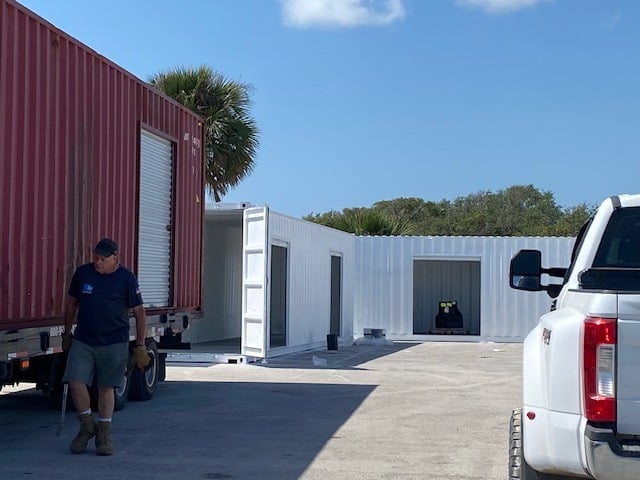
E&S Equipment’s rent-to-own program eliminates the forced choice between renting and buying:
Program Structure:
- Select size and grade (new, cargo worthy, or wind/water tight)
- Choose term: 12, 24, 36, or 48 months
- Make monthly payments with portion applied toward purchase price
- Own outright at term end (no balloon payment, no additional fees)
Key Advantages:
- No credit checks required
- Income-based approval only
- Early payoff rewards with discount on remaining balance
- Flexibility to modify agreement if needs change
- Clear documentation with ownership transfer at completion
Who Benefits from Rent-to-Own Programs
- Small businesses with tight cash flow preserving working capital
- Seasonal operations aligning payments with revenue cycles
- Growing companies adding storage without depleting credit lines
- Property owners testing before full commitment
- Organizations with uncertain timelines needing flexibility
- Credit rebuilding situations establishing payment history
Available Sizes and Grades
Rent-to-own covers most grades and sizes:
- 20ft standard height (8’6″ tall)
- 40ft standard height (8’6″ tall)
- 40ft high cube (9’6″ tall)
- Cargo worthy used units
- Wind and water tight units
- Specialty containers (double door, open side, quad door) by request..
Learn how our rent to own program works.
Key Factors When Choosing
Modification and Customization Options
Rental Restrictions: Most agreements prohibit modifications or severely limit changes. You can’t add doors, windows, ventilation, paint, or structural modifications.
Ownership Freedom: Complete control over modifications including roll-up doors, man doors, windows, wall-mounted AC units, and custom paint.
Roll-up door installations require cutting structural corrugations and reinforcing openings with steel framing to maintain integrity. Man doors are positioned inside walls with door frame welding, weather stripping, and lockable hardware. Window installations include structural reinforcement and options for fixed, sliding, or security bar configurations.
If your application requires any customization, purchasing or rent-to-own is essential. When planning shipping container modifications, working with experienced professionals ensures structural integrity remains intact.
Budget and Cash Flow Considerations
| Financial Situation | Best Option | Reasoning |
| Capital Available | Purchase | Lowest total cost, best long-term value |
| Cash Flow Constrained | Rent-to-Own | Preserves capital while building equity |
| Seasonal Business | Rent-to-Own | Aligns payments with revenue periods |
| Very Short Term | Rental | Avoid purchase commitment for 3-12 months |
Maintenance Requirements
Shipping containers manufactured from corten steel develop a protective rust patina preventing progressive corrosion. Properly maintained units last 25-30 years in stationary storage without structural deterioration.
Basic maintenance includes:
- Keeping drainage channels and door seals clear
- Annual door mechanism inspection
- Ensuring level placement prevents door misalignment
- Roof inspection for standing water (coastal: annual salt washing)
Plywood floors handle typical storage indefinitely but may require replacement under forklift traffic. Steel floor containers eliminate wood maintenance with less insulation from ground temperature.
Read the full guide on buying a shipping container.
New vs Used Quality Standards
Rental Fleet Quality Standards
Rental units show higher exterior wear from multiple relocations, accumulated dents and paint damage, interior cargo residue from various uses, and limited cosmetic condition choice. You don’t select your specific unit. You receive whatever’s available.
Purchase Grade Options
| Grade | Condition | Best For | Warranty |
| New One-Trip | Nearly pristine, one voyage | Appearance matters, modifications | 5 years |
| Cargo Worthy | Certified shipping standard | Quality balance, cost-effective | 2 years |
| Wind/Water Tight | Weather-resistant, not certified | Domestic storage, budget-friendly | 90 days |
Container Grading Standards:
Cargo worthy units meet IICL-5 specifications requiring structurally sound corner posts, header and sill beams within deformation tolerances, floor load capacity meeting ISO 1496 standards, and weather-tight door gaskets.
CSC certification plates document maximum gross weight, tare weight, stacking capacity, manufacture date, and unique identification number. CSC certification expires five years after issuance, requiring re-inspection for continued international shipping.
Wind and water tight units don’t meet current CSC standards but maintain structural integrity for stationary storage. Common reasons for classification include expired CSC plates, minor floor damage exceeding cargo worthy tolerances, or cosmetic rust not compromising structural steel thickness.
Understanding different container grades and conditions helps you select the right quality level for your specific needs and budget.
Why Choose E&S Equipment Sales
We Own Our Inventory
E&S Equipment maintains direct ownership of our entire inventory. We’re not brokers listing units we don’t control. This guarantees accurate condition descriptions, quality control, direct pricing without broker markups, and reliable availability.
30+ Years of Industry Experience
As a licensed container surveyor with over 30 years in the shipping industry, I help customers select appropriate grades, understand quality expectations, navigate delivery logistics, and make informed decisions.
Professional Delivery Service Across FL, GA, and Eastern AL
E&S Equipment provides professional delivery throughout Florida, Georgia, and Eastern Alabama using specialized tilt-bed trucks and CDL-licensed drivers. Delivery radius extends from Macon, Georgia to Miami, Jacksonville to Panama City, and all points between.
Delivery uses hydraulic tilt-bed systems sliding units onto prepared surfaces. Unlike crane delivery requiring overhead clearance, tilt-bed delivery needs only linear approach space. Appointments are scheduled within 2-hour windows with actual placement taking 15-30 minutes on prepared sites.
In-House Modifications and CSC Certification
Available modifications include roll-up doors, man doors, windows, wall-mounted AC units, and custom paint. All performed by experienced technicians understanding structural requirements.
As a licensed container surveyor, I issue CSC certifications for cargo worthy and new units, confirming international shipping safety standards compliance.
Ready to solve your storage needs? Call 800-995-2417 to discuss whether buying, renting, or rent-to-own delivers the best value for your timeline and budget.
Common Questions About Buying vs Renting
Can I test through rental before deciding to buy?
Traditional rental agreements don’t convert to purchase, so rental payments won’t apply toward ownership. Start with rent-to-own rather than traditional rental if you’re uncertain. It provides the testing period while building equity instead of losing payments.
What happens to my rental payments if I decide to buy later?
Traditional rental payments disappear with no credit toward purchase. E&S Equipment’s rent-to-own program addresses this. Every payment contributes toward ownership from day one.
How do delivery fees differ between rental and purchase?
Delivery processes are identical for both. Both require site preparation, access clearances, and level ground. The difference appears at contract end: rentals require pickup scheduling and potential fees, while purchased units remain permanently.
What insurance considerations apply to rented versus owned containers?
Renters carry liability for damage during rental, requiring adequate property insurance coverage. Purchased units should be added to existing property insurance as permanent structures or equipment. Minimal annual cost.
How do financing options compare between purchasing and rent-to-own?
Traditional financing requires credit checks, down payments, and reports to credit bureaus affecting debt ratios. Rent-to-own eliminates credit checks, requires no down payment, and doesn’t impact credit scores. Approved borrowers with strong credit may secure lower rates through traditional financing, while rent-to-own serves customers without financing access. Learn how financing a conex container works.