

Buying a shipping container should be straightforward. You need secure storage, you find a container supplier, you make a purchase. But every week, unsuspecting buyers lose thousands of dollars to shipping container scams, receiving damaged units that don’t match descriptions, dealing with phantom inventory that never existed, or worse: paying deposits that disappear along with the “seller.”
This guide shows you exactly how to avoid shipping container scams, spot warning signs before you commit, and verify that you’re working with legitimate sellers. You’ll learn the critical differences between brokers and direct suppliers, understand what genuine container documentation looks like, and know exactly what questions to ask to protect yourself.
Common Shipping Container Fraud Schemes
Understanding how container scams operate is your first defense. Fraudsters use predictable patterns. Once you recognize these warning signs, you avoid becoming a victim.
Bait-and-Switch Container Condition Fraud
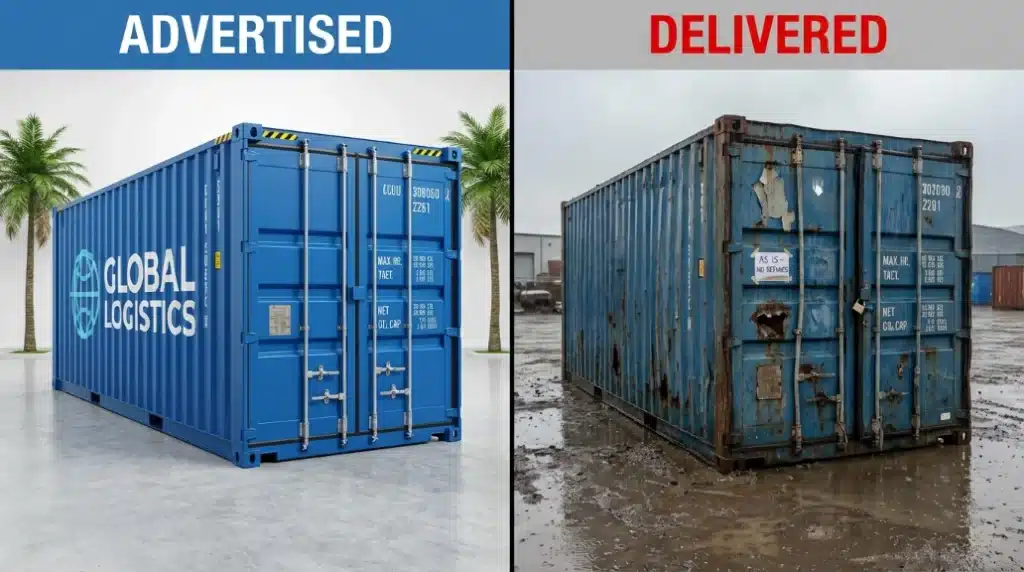
This is the most common scam in the industry. A seller advertises “cargo worthy” containers at competitive prices, shows you photos of pristine units, and collects your payment. When the container arrives, it’s actually wind and water tight grade or worse: an as-is unit with rust, dents, and structural issues.
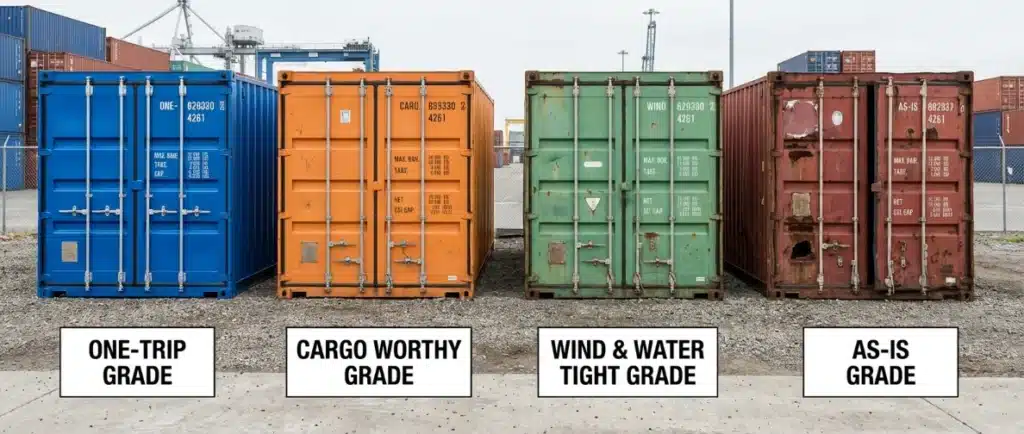
Here’s why this works: most buyers don’t understand container grading standards. Cargo worthy containers meet strict International Convention for Safe Containers (CSC) certification requirements for ocean transport. They’re structurally sound with minimal cosmetic damage. Wind and water tight containers are weatherproof but may have dents, rust, or paint damage that disqualifies them from ocean use. As-is containers may have significant damage including holes, warped doors, or floor issues.
The scammer banks on you not knowing the difference. Professional container surveying involves systematic structural evaluation following international standards: checking load-bearing corner posts for deformation, measuring floor board thickness and integrity, testing door mechanisms under load, and assessing watertight seals. This inspection takes 15-20 minutes per container. Without professional evaluation, sellers easily misrepresent grades.
Phantom Inventory Scams
Container brokers don’t own inventory. They act as middlemen, taking your order and deposit, then scrambling to find a container from their network. This structure creates scam opportunities when unethical brokers:
- Advertise containers they don’t have and can’t actually source
- Collect deposits with no intention of fulfilling orders
- Promise delivery timelines they can’t meet
- Charge fees for containers that never materialize
When working with legitimate direct sellers who own inventory, sourcing takes 7-12 business days. Brokers quote 2-3 day delivery to appear competitive, but then delays compound as they struggle to locate containers, coordinate third-party transport, and manage logistics they don’t control. These delays multiply when multiple brokers compete for limited container supply.
Fake Listing and Cloned Website Scams
Sophisticated scammers create entire fake companies complete with professional websites, stolen photos from legitimate sellers, and convincing business addresses. They clone successful container companies’ websites, changing only contact information and payment details.
These operations advertise containers at prices just below market: appealing enough to attract budget-conscious buyers but not so low they trigger immediate suspicion. They collect deposits via wire transfer or untraceable payment methods, then vanish.
Check domain registration dates using WHOIS lookup. Legitimate container dealers operate domains registered years ago, while scam sites use recently registered domains. Examine website SSL certificates for proper business verification versus basic domain validation. Legitimate companies invest in custom photography showing actual inventory with consistent branding, while fake sites aggregate images from multiple sources with inconsistent quality and watermarks.
Payment and Wire Transfer Fraud
Even when dealing with seemingly legitimate sellers, payment fraud remains common. Scammers insist on wire transfers, cryptocurrency, or other non-refundable payment methods. Once you send the money, recovery is essentially impossible.
Some variations include:
- Requesting full payment upfront (legitimate sellers require deposits)
- Only accepting untraceable payment methods
- Creating urgency around payment to prevent due diligence
- Offering suspicious discounts for “cash deals”
A licensed, insured container company accepts standard business payment methods: credit cards, business checks, ACH transfers. They provide written quotes on company letterhead and issue proper receipts.
Delivery Fee Scams
This scam targets buyers who’ve already committed. You’ve paid for your container, confirmed delivery, and suddenly receive notice of unexpected fees: road permits, crane rental, special equipment charges, or “delivery zone surcharges.”
Legitimate shipping container suppliers provide all-inclusive quotes that include delivery to accessible locations. Additional fees should only apply to genuinely difficult deliveries requiring special equipment, and these are discussed and quoted upfront, not sprung on customers after payment.
Standard container delivery uses tilt-bed or side-loader trucks capable of placing containers on level, accessible surfaces without additional equipment. The delivery process requires about 60 feet of straight-line access for truck maneuvering and 14 feet of vertical clearance. Legitimate additional fees apply only for documented challenges: soft ground requiring timber cribbing, restricted access necessitating smaller transport vehicles, or crane service for elevated placements. These situations are identified during site assessment before quoting.
Ten Shipping Container Scam Warning Signs
These red flags should immediately raise concerns. Individually, they might be explained away. Together, they paint a clear picture of fraudulent operations.
Warning Sign 1: Below-Market Pricing
If someone offers a 40-foot cargo worthy container significantly below market rates, something’s wrong. Scammers use below-market pricing to attract victims. Legitimate container suppliers operate on thin margins and can’t drastically undercut market rates while maintaining quality and service standards.
Warning Sign 2: No Physical Container Depot or Yard Location
If a company won’t provide a physical business address where you can visit and inspect inventory, they’re operating as an unlicensed broker or outright scam. Legitimate sellers maintain storage yards where inventory is kept.
Commercial container operations require suitable real estate: hard-packed surfaces supporting 67,200-pound gross container weights, perimeter security with controlled access, adequate spacing for forklift maneuvering (minimum 12-foot aisles), and proper drainage. Companies operating from residential addresses or mailbox services lack infrastructure for legitimate container sales.
E&S Equipment Sales maintains a physical location at 637 SW SR-47, where customers can schedule appointments to view inventory. We’re transparent about our operations because we have nothing to hide.
Warning Sign 3: Vague Container Condition Descriptions
Scammers keep descriptions generic to avoid accountability. “Good condition,” “normal wear,” or “ready for use” mean nothing without specifics. Legitimate dealers provide detailed condition reports including:
- Specific container grade (cargo worthy, wind and water tight, etc.)
- Manufacturing year
- Exterior and interior condition descriptions
- Door operation status
- Floor condition
- Any modifications or damage
Professional assessment follows systematic evaluation criteria established by international surveying organizations. Exterior assessment documents paint condition percentage, rust severity using standardized scales, dent depth measurements, and structural deformation. Interior evaluation includes floor board integrity testing, sidewall inspection for light penetration, cargo residue presence, and odor assessment.
Warning Sign 4: High-Pressure Sales Tactics
“This container won’t last,” “I have three other buyers ready to pay,” “Price goes up tomorrow.” These urgency tactics push you to commit before conducting proper research. Scammers know that informed buyers rarely fall for their schemes.
Responsible container purchases involve several business days for research, site preparation planning, and internal approval processes. Commercial buyers require multiple quotes for purchasing protocol compliance. Reputable container dealers accommodate these reasonable decision timelines because they maintain regular inventory replenishment.
Warning Sign 5: Website Red Flags
Professional-looking websites can still be scams. Look deeper for:
- Recently registered domains (check WHOIS records)
- No detailed company history or about page
- Stock photos instead of actual inventory images
- Missing contact information beyond a form
- No physical address listed
- Poor grammar or obvious template content
- No verifiable reviews or testimonials
Domain age verification through WHOIS databases reveals registration dates. Legitimate companies operate domains registered multiple years ago. Image reverse-searching using Google Images identifies stolen photography from legitimate sellers.
Warning Sign 6: No Licensing, Insurance, or Industry Certifications
Container sellers should carry proper business licensing and insurance. They should be registered with their state and ideally hold memberships in industry organizations like the National Portable Storage Association (NPSA). Scammers avoid official channels that require verification.
Legitimate container operations maintain comprehensive commercial general liability insurance, commercial vehicle insurance for delivery trucks, and workers compensation coverage. These policies require insurance carrier underwriting evaluating business operations, safety records, and financial stability. Insurance certificates provide third-party verification of legitimate operations because carriers won’t insure fraudulent entities.
Warning Sign 7: Refusal to Provide Customer References
Established container companies have completed hundreds or thousands of sales. They can provide references from satisfied customers, show examples of past projects, and demonstrate their track record. Scammers can’t.
Professional reference checking involves contacting previous customers directly to verify transaction details, delivery timeliness, container condition accuracy, and problem resolution responsiveness. Legitimate sellers maintain customer relationship management systems documenting sales history and can provide relevant references matching your purchase type.
Warning Sign 8: Communication Issues
How does the seller communicate? Professional businesses maintain consistent communication through business email addresses, return phone calls promptly, and provide clear written documentation.
Red flags include:
- Only communicating via text message
- Using generic email addresses (Gmail, Yahoo)
- Inconsistent or evasive responses
- Refusing to provide written quotes
- Poor English suggesting overseas operations
- Unwillingness to discuss details over phone
Legitimate businesses operate during defined hours with staff answering calls professionally. Email communications originate from company domain addresses. Written quotes appear on company letterhead showing business registration details. Response times range 2-4 hours during business hours.
Warning Sign 9: Payment Method Restrictions
Legitimate businesses accept standard payment methods: credit cards, business checks, ACH transfers. They provide proper receipts and documentation. Scammers insist on untraceable payment methods like:
- Wire transfers only
- Cryptocurrency
- Money orders to individuals
- Cash payments
- Payment to personal accounts
Merchant account services enabling credit card acceptance require business verification including tax identification numbers, bank account verification, business licensing documentation, and background checks. Payment processors evaluate business legitimacy before approving accounts. Companies operating without merchant accounts either can’t pass verification requirements or avoid credit card transactions to prevent chargeback disputes when delivering inferior products.
Warning Sign 10: Missing or Suspicious Container Documentation
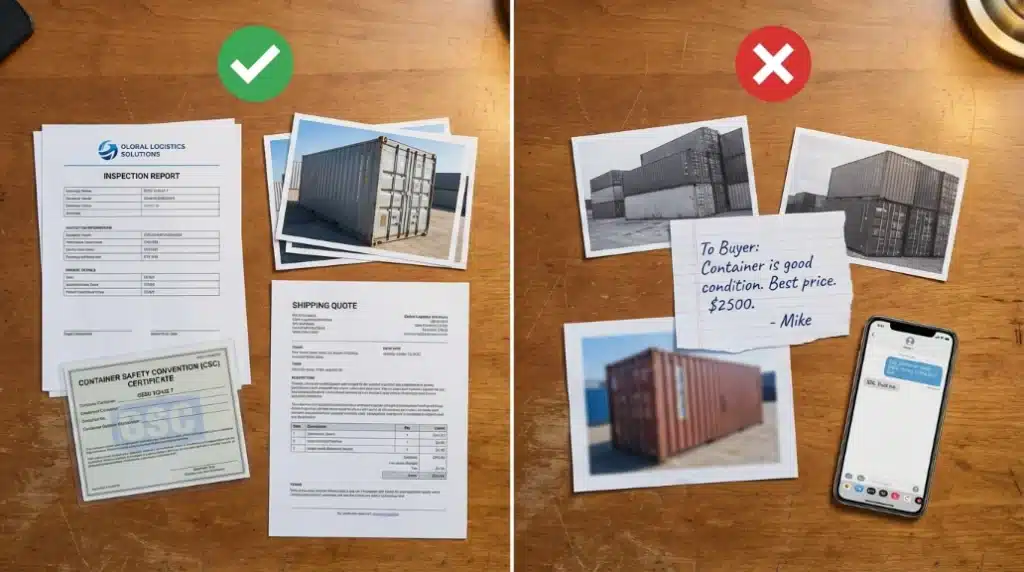
Every shipping container has a unique identification number and CSC certification plate. Legitimate sellers can photograph specific containers showing these identifiers. Scammers use generic photos and avoid providing container-specific documentation.
Before payment, legitimate sellers should provide:
- Photos of your specific container showing ID number
- CSC plate details
- Written condition assessment
- Delivery timeline confirmation
Each shipping container receives a unique 11-character identification code at manufacturing following ISO 6346 standards. This identification appears on container doors, sidewalls, and roofs. CSC plates contain manufacturing dates, maximum gross weight ratings, test dates, and approval country codes. Legitimate sellers photograph these specific identifiers proving they possess the actual container being sold.
Brokers vs. Direct Shipping Container Sellers
Understanding this distinction is critical for avoiding scams. Many buyers don’t realize they’re dealing with brokers until problems arise.
How the Broker Model Creates Fraud Opportunities
Container brokers operate as intermediaries without owning inventory. They advertise containers they don’t physically possess, collect orders and deposits, source containers from suppliers, and coordinate delivery through third parties.
This model isn’t inherently fraudulent, but the structure creates scam opportunities:
Accountability gaps: When something goes wrong, brokers blame suppliers. Suppliers claim they fulfilled the broker’s order correctly. Customers get trapped in the middle with no clear resolution path.
Condition misrepresentation: Brokers haven’t seen the containers they’re selling. They rely on supplier descriptions, which may be inaccurate. When a “cargo worthy” container arrives in wind and water tight condition, the broker claims the supplier made the error.
Phantom inventory: Unethical brokers advertise containers they can’t actually source, collecting deposits and hoping to find inventory later. If they can’t, they delay delivery indefinitely while keeping your money.
Most container brokers structure operations as limited liability companies with minimal capitalization. When disputes arise, buyers face collection challenges even when winning legal judgments. Brokers can dissolve operations and restart under new business names avoiding accountability.
What Direct Container Sellers Offer
Direct container sellers like E&S Equipment Sales own their inventory. This fundamental difference provides significant advantages:
Inventory control: Direct sellers inspect containers before purchase, understanding exactly what they’re selling. Our licensed surveyor physically examines each unit, ensuring it meets our quality standards.
Accountability: When you buy direct, there’s one responsible party. If issues arise, you’re dealing with the company that owns and controls the container.
Faster delivery: No middleman coordination means streamlined logistics. We control our trucks, our containers, and our delivery schedule.
Modification capabilities: Direct sellers provide in-house modification services. We’ve been modifying containers for 15 years, installing man doors, roll-up doors, windows, and custom paint. Brokers can’t offer this because they don’t own the containers or have modification facilities.
Direct sellers develop container sourcing relationships directly with shipping lines and ports, establishing quality standards for purchased inventory. This enables consistent grading criteria across inventory rather than accepting whatever suppliers provide.
Container Supplier Verification Questions
Before committing to any container purchase, ask these specific questions:
“Do you own the container I’m purchasing, or are you sourcing it from a supplier?”
Legitimate direct sellers clearly state they own inventory. Brokers dodge this question or provide vague responses about “partnerships” and “network suppliers.”
“Can I visit your yard to inspect containers before purchasing?”
Direct sellers welcome yard visits. Brokers claim this isn’t possible due to “security” or “containers being stored at multiple locations.”
“Who will deliver the container, your company or a third party?”
Direct sellers use their own trucks and drivers (all our drivers are CDL licensed). Brokers coordinate with third-party transport companies.
“Can you show me photos of the specific container I’ll receive with its unique ID number visible?”
Direct sellers can photograph specific units in their yard. Brokers use generic stock photos or images from suppliers.
How to Verify Container Condition and Seller Legitimacy
Due diligence separates informed buyers from scam victims. These steps take minimal time but provide maximum protection.
Step 1: Verify Business Registration and Licensing
Every legitimate container company is registered with their state and maintains proper business licensing. Verify this through your state’s business entity database. Confirm the company is registered, in good standing, and has been operating for a reasonable period. Most states provide online databases showing corporation formation dates, registered agents, and current status. Look for filing history spanning multiple years.
Container sellers need appropriate business licenses for their operations. Check with local authorities or state licensing boards. Verify the business address matches the license address.
Companies working with government entities should appear in SAM.gov (System for Awards Management). SAM.gov registration requires extensive documentation including tax identification verification, bank account information, and principals’ background disclosure.
Request proof of liability insurance. Insurance certificates should show current policy dates, coverage amounts, and insurer contact information. Call the insurance agency listed to verify policy authenticity.
Step 2: Check Reviews Across Multiple Platforms
Single-source reviews can be manipulated. Cross-reference feedback across:
- Google Reviews (check review dates and details)
- Better Business Bureau ratings and complaint history
- Facebook page reviews
- Construction and trade forums
Look for patterns in negative reviews. Occasional complaints are normal, but consistent issues with container condition, delivery problems, or customer service suggest systemic problems.
Legitimate businesses accumulate reviews gradually over time showing varied customer experiences and specific project details. Review content specificity indicates authenticity. Legitimate customers mention delivery driver names, specific container features, timeline details, and problem resolution experiences.
Step 3: Confirm Physical Location and Inventory
Visit the seller’s location if possible. If distance prevents visiting, request live video tours showing their yard and inventory. During video tours, request specific views: ask to see the storage yard entrance with visible signage, request container identification number close-ups on multiple units, and ask staff to walk through inventory demonstrating quantity and variety.
Search the physical address online. Is it a commercial property suitable for container storage? County property appraiser websites show property ownership, zoning classification, and aerial photography.
Google Maps satellite view shows whether a location actually has container storage capability. Verify visible containers match claimed inventory levels.
Step 4: Validate Inspection and Certification Capabilities
Container grading requires expertise. Ask about:
- Who inspects containers before sale
- What certifications or credentials inspectors hold
- Whether they can provide CSC certificates for international shipping
Container surveying certifications come from organizations like the International Institute of Container Lessors (IICL). Ask for surveyor names and certification numbers, then verify credentials directly with issuing organizations.
E&S Equipment Sales benefits from our owner’s licensed container surveyor credentials. This expertise ensures accurate grading and provides certification capabilities that most competitors lack.
Step 5: Review Website and Communication Quality
Professional operations maintain professional communications. Legitimate websites include:
- Detailed company history and background
- Comprehensive product information
- Clear contact information including physical address
- Professional photography of actual inventory
- Educational content demonstrating expertise
Legitimate businesses invest in educational content demonstrating industry expertise. Look for detailed articles explaining container grades, modification options, delivery logistics, and maintenance recommendations. Websites lacking substantial content beyond product listings indicate minimal investment in customer education.
Understanding Shipping Container Grades and Fair Pricing
Price confusion enables scams. Understanding container grades and their market values helps you recognize when “deals” are actually red flags.
The Four Standard Shipping Container Grades
New One-Trip Containers: Made just one overseas voyage carrying cargo, then retired from ocean service. Essentially new with minimal exterior wear, clean interiors, and pristine structural condition. Interior cleanliness allows immediate use without extensive cleaning.
Manufacturing follows ISO 668 dimensional standards and ISO 1496-1 structural requirements. Steel specifications use Corten steel (weathering steel) with 2mm thickness for sidewalls. Floor systems use 28mm marine-grade plywood over steel crossmembers.
Cargo Worthy (CW) Used Containers: Meet International Convention for Safe Containers (CSC) certification requirements for ocean transport. They’re structurally sound with watertight integrity but show cosmetic wear from cargo service: paint fading, minor dents, surface rust.
Cargo worthy certification requires passing structural examinations covering corner post integrity, floor load capacity, roof strength, door operation, gasket sealing, and watertight integrity. The CSC plate indicates test dates. Certification expires five years after initial approval, requiring re-inspection for continued ocean service.
Wind and Water Tight (WWT) Containers: Maintain weatherproof integrity but don’t meet cargo worthy certification standards. They might have dents affecting appearance, paint damage, or minor rust that disqualifies them from ocean transport.
WWT containers work perfectly for ground-based storage where appearance isn’t critical. The distinction between WWT and cargo worthy involves structural certification rather than basic functionality. WWT containers seal against weather but might have door alignment issues preventing proper locking mechanism operation or floor boards with minor soft spots inadequate for concentrated cargo weight.
Why Container Prices Vary
Container pricing fluctuates based on several factors:
Market dynamics: Container availability follows international trade patterns. The United States imports significantly more goods than it exports, creating container accumulation at domestic ports. This trade imbalance creates supply pressure that reduces prices in markets with high import volumes.
Location: Containers are cheaper near major ports where supply concentrates. Container prices near Jacksonville, Savannah, or Miami ports run lower than prices in rural locations. Each 100 miles from major ports adds transportation costs.
Modifications: Custom work adds cost based on complexity. Man door installation involves cutting steel sidewalls, reinforcing opening perimeters with steel framing, installing commercial-grade doors with weather sealing, and finishing with paint matching.
Red Flag Pricing
When encountering pricing substantially lower than market rates, calculate whether the economics make sense. Consider wholesale container acquisition costs, transportation from ports, reconditioning investments, business overhead, and profit margins. If pricing seems too low to cover these costs, sellers either misrepresent container conditions or operate unsustainably and will cease operations.
What Legitimate Container Documentation Looks Like
Documentation separates legitimate transactions from scams. Understanding what to expect protects you.
The CSC Safety Approval Plate
Every container built for international transport carries a CSC plate: a metal plate on the left door providing critical information including country of approval, date of manufacture, container identification number, maximum gross weight, and test dates and approval stamps.
The CSC plate contains specific information in standardized format. The country code indicates manufacturing location and approval authority. Manufacturing date appears in MM/YY format. Maximum gross weight (MGW) listing indicates total allowable loaded weight. When examining CSC plates, verify manufacturing dates align with claimed container age and approval dates remain current for cargo worthy certification.
Container Inspection Certificates and Reports
Professional container sellers provide inspection reports documenting:
- Overall structural condition
- Door operation and locking mechanisms
- Floor condition and cargo worthiness
- Exterior damage assessment
- Interior cleanliness
- Roof and seal integrity
Comprehensive inspection reports include photographic documentation from multiple angles showing container ID numbers, CSC plates, door mechanisms, floor conditions, and any damage areas. Written assessments describe structural integrity using industry-standard terminology referencing IICL grading criteria. Reports document specific measurements including dent depths, rust severity classifications, and floor board conditions.
How to Spot Forged Container Documentation
Scammers sometimes provide fake documentation. Red flags include:
Generic photos: Documentation should show your specific container with unique ID number visible. Stock photos or images that don’t match the container ID suggest fraud.
Incomplete information: Complete documentation includes container specifics like manufacturing date, identification number, and inspection dates. Vague or incomplete paperwork raises concerns.
Authenticate documentation by verifying container identification numbers follow ISO 6346 format: four letters (owner code), six digits (serial number), and one check digit calculated using specific algorithms. Request multiple photos from different angles showing same container ID proving documentation corresponds to specific unit.
Seven Safe Container Buying Practices
Research extensively before committing. Spend time investigating sellers, reading reviews, verifying registration, and understanding container grades. Create comparison spreadsheets evaluating multiple sellers across criteria including business longevity, review quality, licensing verification, and pricing.
Visit facilities or request comprehensive video tours. Nothing replaces seeing operations firsthand. Schedule facility visits during business hours when staff and operations are active. For distance-prevented visits, request live video calls showing real-time yard conditions with date/time verification.
Demand container-specific documentation before payment. Request minimum six photographs per container showing all four sides, both doors with visible identification numbers and CSC plates, and floor conditions. Photos should include date stamps proving recency. Video documentation provides superior verification.
Use protected payment methods. Credit cards and business checks provide dispute resolution and buyer protection. Credit card payments enable chargeback disputes if sellers fail delivering promised goods. Establish payment schedules splitting deposits and final payments rather than full upfront payment.
Get everything in writing. Written agreements should specify:
- Exact container grade using industry-standard terminology
- Dimensions and type
- Delivery location with placement requirements
- Delivery timeline with specific dates
- Total costs including delivery fees
- Payment terms and schedule
- Warranty terms
Verify delivery logistics before committing. Confirm delivery truck type and capabilities. Clarify site access requirements including road width minimums, overhead clearance, and ground surface hardness. Understand placement limitations: standard service places containers on level, accessible ground.
Trust your instincts. If something feels wrong (pressure tactics, evasive answers, reluctance to provide information), walk away. Pay attention to subtle indicators including communication responsiveness consistency, willingness providing detailed information, and transparency regarding business operations.
What to Do If You’ve Been Scammed
Despite precautions, some buyers fall victim to container scams. Taking immediate action may help recover funds.
Immediate Actions
Document everything: Compile all communications, photos, quotes, receipts, and documentation. Create comprehensive files including:
- Email correspondence
- Text messages
- Phone call logs
- Payment records
- Advertisement copies
- Any contracts
Contact your bank immediately: If you paid via wire transfer or ACH, contact your bank’s fraud department immediately. While recovery is challenging, some transfers can be stopped if caught quickly. Time-sensitivity matters critically: wire transfers become irreversible within hours.
Dispute credit card charges: If you paid by credit card, file a dispute with your card issuer. File disputes immediately after fraud recognition, within 60-90 days of transaction dates. Provide comprehensive evidence including promised condition descriptions and actual received condition documentation.
Cease further payments: Don’t send additional money based on promises that more payment will resolve problems. Fraud escalation tactics involve requesting supplementary payments allegedly covering “unexpected” delivery complications.
Where to Report Container Scams
Report scams to:
- Federal Trade Commission (FTC) at ReportFraud.ftc.gov
- Your State Attorney General through consumer protection divisions
- Better Business Bureau to create public documentation warning potential victims
- Internet Crime Complaint Center (IC3) at IC3.gov for online transactions
- Local law enforcement to file police reports for official documentation
Recovery Expectations
Be realistic about recovery prospects. Wire transfers are essentially irreversible once processed. Cryptocurrency transactions can’t be reversed. Your best recovery chances involve credit card disputes or small claims court for local scammers.
Most scam victims don’t recover funds. The best approach is prevention, which is why understanding how to avoid shipping container scams before making purchases is critical.
Why Buying From E&S Equipment Sales Protects You From Container Scams
After understanding scam tactics and verification methods, the reason to choose E&S Equipment Sales becomes clear: we eliminate scam risks through transparent, professional operations.
We Own Our Inventory
We’re not middlemen. We own every container we sell, maintaining our own storage yard. This direct ownership means:
- No broker accountability gaps
- No phantom inventory situations
- No multiple markups
- Complete control over quality and delivery
Direct inventory ownership enables immediate container availability verification, accurate condition representation based on actual physical inspection, and delivery scheduling control using our own transportation resources. We purchase containers directly from shipping lines and ports, controlling reconditioning processes ensuring consistent quality standards.
Licensed Container Surveyor on Staff
Our owner’s licensed container surveyor credentials provide advantages most competitors can’t match:
- Professional surveyor inspection ensures accurate grading following established standards
- CSC certification capability for international shipping
- Quality assurance with every container receiving professional inspection before sale
Surveyor licensing requires extensive training in container structural evaluation, CSC certification standards, and international transport regulations. Container grading becomes objective assessment against documented standards rather than subjective seller opinion.
30+ Years of Intermodal Experience
Our owner began his shipping container career in the early 1990s working as Logistics and Maintenance Manager for major cargo shipping lines. We’ve operated E&S Equipment Sales since 2010, selling over 11,000 containers to government entities, municipalities, construction companies, agricultural operations, and individual customers throughout Florida and Georgia.
Decades of industry involvement provide insights impossible to replicate through short-term operations. We’ve witnessed market cycles, supply fluctuations, and quality variations across container manufacturing eras.
Ready to purchase a container without scam worries? Contact E&S Equipment Sales at 800-995-2417 or visit our facility at 637 SW SR-47 by appointment. Get a written quote from a licensed container surveyor who’s actually seen your container and can certify its condition.
FAQ
How can I tell if a container seller is legitimate before I pay anything?
Verify business registration through your state’s corporate database, check reviews across multiple platforms for consistent feedback patterns, confirm they maintain a physical yard location you can visit or video tour, and ask to see photos of your specific container showing its unique identification number. Legitimate sellers readily provide this verification because they operate transparently with proper licensing and inventory ownership.
What’s the difference between buying from a broker vs. a direct container supplier?
Brokers don’t own inventory. They take your order and source containers from suppliers, creating accountability gaps when problems arise. Direct sellers own their containers, control quality through inspection, manage delivery with their own drivers, and provide single-point accountability. Direct sellers also offer faster delivery timelines because they don’t coordinate through third parties.
What should I do if I’ve already paid a deposit but haven’t received my container?
Contact the seller immediately requesting detailed delivery timeline confirmation with specific dates, ask for photos of your actual container with identification numbers visible proving it exists, and request written delivery commitment. If responses are evasive or delayed, contact your bank or credit card company immediately to dispute the charge and document all communications for potential fraud reporting.
What documents should I receive when buying a shipping container?
Legitimate sellers provide written quotes on company letterhead specifying exact container grade and specifications, photos of your specific container showing ID numbers and CSC plates, detailed condition assessment documenting any damage, delivery confirmation with timeline and placement details, and proper receipts upon payment. For international shipping, request CSC certificates confirming ocean transport certification from licensed surveyors.