
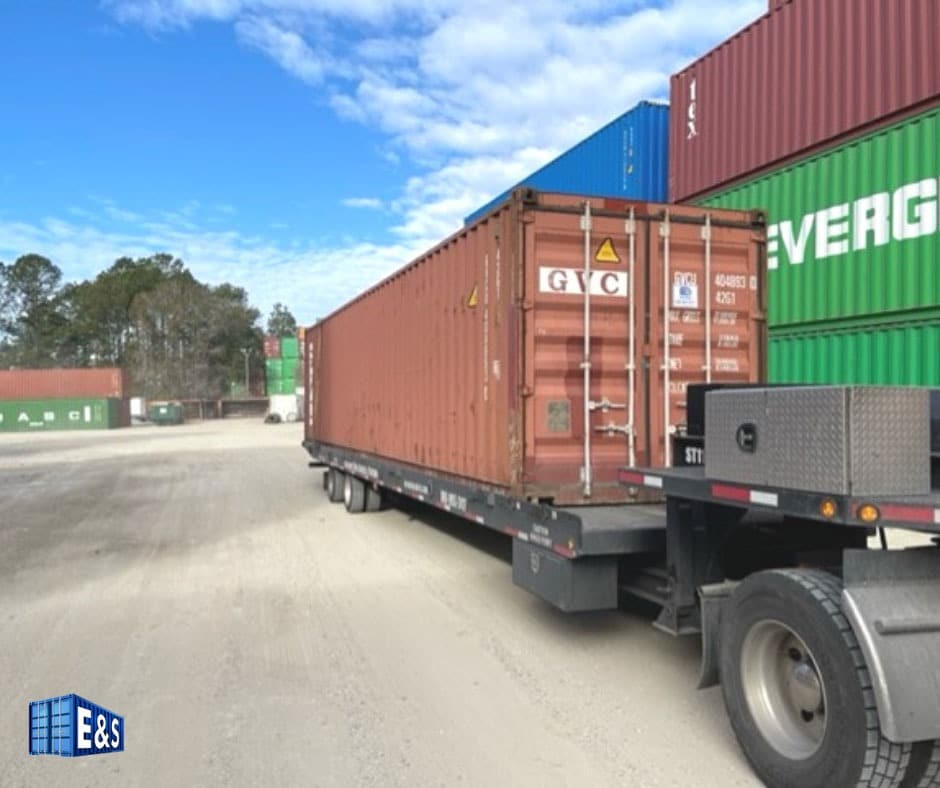
When you invest in a shipping container, logistics is usually the biggest question mark. Will the delivery truck fit? What about overhead power lines? How do you prepare the ground?
E&S Equipment Sales Inc. has completed over 11,000 shipping container deliveries across Florida, Georgia, and Eastern Alabama since 2010. Our CDL-licensed drivers and specialized equipment get your container to you safely and placed exactly where you need it.
This guide covers instant freight quotes, site preparation, delivery methods, and what happens on delivery day.
What is the process?
Step 1: Scheduling your delivery
After order confirmation and deposit, we schedule delivery within 7-12 business days for in-stock containers.
Before delivery, we confirm:
- Exact delivery address and site access details
- Specific placement location
- Site access concerns (narrow roads, overhead clearance, soft ground)
- Preferred delivery method
- Who will accept delivery and sign off
You receive:
- 24-48 hour advance notice
- Morning-of confirmation with arrival window
- Direct driver contact number for coordination
Step 2: Final confirmation & driver communication
The day before delivery, we confirm your window. On delivery day, your driver calls 30-60 minutes before arrival.
What our driver needs:
- Clear access (gates unlocked, vehicles moved, pets secured)
- Confirmation that ground is prepared and obstacles removed
- Your availability for final inspection walk-through
Step 3: Arrival & container unloading
The driver assesses the approach and confirms placement with you. Depending on the delivery method, unloading takes 15-45 minutes.
Your role during delivery:
- Stay in communication with the driver
- Keep safe distance from truck and container
- Alert driver to concerns before container is set down
- Be available for questions about placement
Safety is our priority. Our drivers are trained to identify hazards and will stop if conditions aren’t safe, we’d rather reschedule than risk damage or injury.
Step 4: Final inspection & sign-off
Inspect thoroughly before signing the delivery receipt.
What to check:
- Exterior condition: Any undocumented damage
- Door operation: Both doors function smoothly
- Interior condition: Floor, walls, and ceiling match your purchase
- Container number: Matches your paperwork
- Placement accuracy: Positioned where requested
Choosing the best delivery method for your site
Understanding your three delivery options makes site preparation straightforward.
Tilt-bed truck delivery (most common & cost-effective)
A hydraulic tilt-bed truck tilts backward, letting the container slide off onto the ground using gravity.
Truck specifications:
| Specification | Measurement |
|---|---|
| Total length (truck + 40ft container) | ~60 feet |
| Width | 8.5 feet |
| Height (loaded) | 13.5 feet |
| 20ft container weight | ~5,000 lbs |
| 40ft container weight | ~8,000-9,000 lbs |
Site requirements:
- Width: Minimum 12 feet clear width (14 feet ideal)
- Length: 60 feet straight backing distance (40ft container); 40 feet (20ft container)
- Overhead clearance: Minimum 14 feet along entire route
- Ground: Firm, level surface
Best for: Open areas with direct, straight-line access, residential backyards with side-yard access, commercial sites with loading areas, agricultural properties, and construction sites.
Won’t work if: Narrow driveways with sharp turns, overhead obstructions below 14 feet, extremely soft ground, or containers must be lifted over fences/walls.
Flatbed truck delivery
The container stays on the flatbed until your equipment (forklift or crane) removes it.
Requirements:
- Forklift with 10,000 lb capacity (20ft container) or 15,000 lb capacity (40ft container)
- Forks extending at least 8 feet
- Experienced equipment operator
Best for: Commercial/industrial facilities with material handling equipment, construction sites with crane services, or sites needing precise placement over obstacles.
Important: You’re responsible for safely offloading the container. Our driver cannot operate your equipment for liability reasons.
Crane/Hiab truck delivery for complex placement
A hydraulic crane mounted on our truck lifts the container over obstacles, fences, or into tight spaces.
Crane specifications:
- Reach: 20-30 feet horizontally and vertically
- Operation time: 45-90 minutes
- Requires stable ground for outriggers
Best for: Fenced backyards without side access, placement over walls/hedges/landscaping, rooftop installations, narrow/winding access preventing tilt-bed delivery, or urban locations needing street positioning.
Cost: Premium method, around $400-800 more than tilt-bed due to specialized equipment and longer setup time.
Critical safety note: We cannot operate cranes near live power lines. Contact your utility company for clearance assessment before scheduling crane delivery.
Site preparation guide for container delivery
Proper site preparation is the most important factor in successful delivery.
Access and clearance requirements
Horizontal space for tilt-bed delivery:
| Container Size | Minimum Width | Straight Backing Distance |
|---|---|---|
| 20ft container | 12 feet | 40 feet |
| 40ft container | 12 feet | 60 feet |
Vertical clearance:
- Minimum 14 feet along entire access route for tilt-bed delivery
- Check property entrances, driveways, and placement site
- 15+ feet clearance from power lines (non-negotiable)
Common overhead hazards:
- Power lines (extremely dangerous, maintain 15+ feet clearance)
- Phone/cable lines (usually 12-15 feet, may need temporary removal)
- Tree branches below 14 feet blocking route
- Roof overhangs, carports, porches
- Gate arbors and pergolas
If clearance is limited: Contact your utility company about temporarily raising lines (often free), or consider crane services.
Ground preparation & foundation options
Your container sits on four corner castings bearing the entire weight. Proper foundations for your shipping container prevent settling, shifting, and structural stress.
Why level matters:
- Doors operate properly (even a few inches of tilt causes binding)
- Maintains structural integrity
- Water drains correctly
- Interior shelving and storage function correctly
Level tolerance: Within 1-2 inches over container length (ideal); 3 inches acceptable; 4+ inches problematic.
| Foundation Type | Cost | Installation Time | Best For |
|---|---|---|---|
| Gravel Pad | $200-500 | 4-6 hours | Long-term residential storage |
| Concrete Piers | $400-800 | 1 week (curing) | Permanent installations |
| Railroad Ties | $100-200 | 1-2 hours | Temporary placements |
| Existing Concrete | $0 | None | Commercial properties |
Gravel pad construction:
- Mark container footprint plus 1-2 feet on all sides
- Excavate 4-6 inches of topsoil
- Install landscape fabric to prevent weeds
- Fill with 3/4″ crushed gravel
- Compact thoroughly with plate compactor
- Check and adjust for level before delivery
Concrete pier construction:
- Mark four corner casting locations
- Dig holes 12-18 inches deep and 12 inches wide
- Pour concrete piers with tops 4-6 inches above ground
- Level across all piers while concrete is workable
- Allow 7 days curing before delivery
Pier dimensions: 12″×12″×12″ minimum; 16″×16″×18″ recommended for clay or soft soils.
Final site check: 48 hours before delivery
Walk your access route and placement site to clear obstacles:
Clear these obstacles:
- Vehicles, trailers, RVs from driveways
- Potted plants, lawn furniture, decorations
- Construction materials and equipment
- Recreational equipment
- Garbage cans and recycling bins
Secure these hazards:
- Pets away from delivery area
- Children supervised at safe distance
- Gates unlocked/opened or removed if too narrow
- Sprinkler systems marked to prevent damage
Mark these locations:
- Septic tanks and drain fields that truck must avoid
- Underground utilities (call 811 before delivery)
- Property boundaries
- Final container position (four corner locations)
Understanding container delivery costs
Several factors influence your delivery quote. Understanding these helps you plan your budget and choose the most cost-effective method.
Key cost factors
Distance from Nearest Depot
Delivery costs increase with distance from the supplier’s nearest depot location. Most container companies maintain multiple depot locations and calculate delivery from whichever is closest to your site. Longer distances mean higher fuel costs, driver time, and equipment wear.
Container size impact:
- 10ft & 20ft containers: Standard cost (baseline)
- 40ft & 45ft containers: Higher cost due to longer truck and complex maneuvering
Delivery method pricing:
- Tilt-bed: Most economical (included in base quotes)
- Flatbed: Similar to tilt-bed (you provide offloading equipment)
- Crane: Premium method, around $400-800 more than tilt-bed
Get the most accurate quote
Provide these details when requesting quotes:
- Delivery address and zip code
- Container size needed (10ft, 20ft, 40ft, or 45ft)
- Access description (straight driveway, side-yard access, requires crane)
- Overhead clearance concerns (trees, power lines, structures)
- Ground conditions (paved, gravel, grass, soft soil)
- Gate widths through fenced areas
- Placement location (front yard, backyard, commercial lot)
- Timeline needs (standard or expedited)
Photos help tremendously: Send photos of street view, driveway/access route, placement site, overhead obstacles, and gate openings.
Troubleshooting delivery challenges
Pre-delivery site assessment
We gather detailed site information during ordering to avoid delivery day surprises:
- Complete delivery address and property description
- Access routes and overhead clearance
- Ground conditions and gate widths
- Special circumstances (HOA restrictions, neighboring property considerations)
For challenging deliveries, narrow access, unclear clearance, crane requirements, or complex commercial sites, we recommend a pre-delivery site visit. This 30-minute visit confirms the best approach and provides accurate costs.
Request a site assessment: Call 800-995-2417 if you’re uncertain about access or want confirmation before delivery.
Common delivery issues & solutions
| Issue | Solution |
|---|---|
| Narrow driveway | Measure carefully (need 12′ minimum); temporary gate removal; crane delivery from street |
| Low tree branches | Tree trimming before delivery; route adjustment; crane if obstruction is only at entrance |
| Soft ground after rain | Rescheduling; temporary access matting/plywood; crane from paved surface |
| Overhead power lines | Contact utility for line assessment; temporary raising/removal (often free); alternative placement |
| Unknown HOA restrictions | Review covenants before ordering; deliver to temporary location pending approval; relocation services available |
Contingency planning: unsuccessful delivery scenarios
Driver determines delivery is unsafe:
If our driver arrives and conditions are unsafe, overhead clearance issues, ground conditions, access problems, the driver will not proceed.
What happens: Driver communicates the specific issue, we discuss alternative solutions, delivery is rescheduled once resolved. Redelivery fees may apply if the issue wasn’t communicated during ordering.
Customer not present or site unprepared:
Delivery requires the customer (or authorized representative) present for final placement confirmation and inspection.
If no one is on-site: Driver attempts to contact you within 15 minutes. If unsuccessful, the driver returns to the depot. Delivery rescheduled with redelivery fees applied.
Obstacles discovered on delivery day:
If previously uncommunicated obstacles prevent delivery (vehicles blocking access, locked gates, unprepared ground), we’ll work with you to resolve within 20-30 minutes. If immediate resolution isn’t possible, delivery is rescheduled and redelivery fees may apply.
Clear communication prevents 95% of delivery problems.
Ready for worry-free shipping container delivery?
E&S Equipment Sales has delivered 11,000+ containers throughout Florida, Georgia, and Eastern Alabama since 2010. We’ve navigated every scenario, from tight residential backyards to complex commercial job sites.
What sets our services apart:
✓ Professional CDL-licensed drivers with company-owned equipment
✓ 15 years delivery experience with owner’s 30+ years in intermodal industry
✓ Fully licensed and insured with comprehensive coverage
✓ Transparent written quotes, no hidden fees
✓ Local service, not out-of-state brokers
✓ NPSA member 11+ years, FSSA member 8+ years
✓ 80% same-day response rate to inquiries
Get started with professional container delivery today
Two ways to contact us:
- Call: 800-995-2417 (Mon-Fri 9am-6pm, Sat 9am-noon)
- Request a quote online
Have ready when contacting us:
- Delivery zip code or address
- Container size needed (10ft, 20ft, 40ft, 45ft)
- New or used container preference
- Brief site access description
- Desired timeframe
Explore our container inventory:
- New 1-Trip containers (like-new, 5-year warranty)
- Cargo Worthy used containers (certified quality, 2-year warranty)
- Specialty containers (double-door, open-side, refrigerated, quad-door)
- Container modifications (roll-up doors, windows, custom paint)
Budget-conscious about delivery cost? Ask about our rent-to-own program with no credit checks, 12-48 month terms, and 33% early payoff discount.
Need more guidance? Our shipping container buying guide covers sizes, types, pricing, and red flags. Explore our container financing guide for equipment loans, rent-to-own options, and payment strategies.
Frequently asked questions about shipping container delivery
How much space do you need for shipping container delivery?
Tilt-bed delivery (most common):
Width: Minimum 12 feet clear (14 feet ideal)
Length: 60 feet straight backing (40ft container); 40 feet (20ft container)
Height: Minimum 14 feet overhead clearance
Crane delivery:
Truck positioning: 50-60 feet (can be in street)
Crane swing radius: 20-30 feet clear zone
Overhead clearance: Minimum 15 feet from power lines
Measure carefully along the entire route. If uncertain, request a pre-delivery site visit for assessment.
Do I need to be present for shipping container delivery?
Yes, you (or an authorized representative) must be present to:
Confirm final placement location before unloading
Answer last-minute questions about site conditions
Conduct final inspection
Sign delivery receipt confirming acceptance
If you cannot be present: Designate an authorized representative, inform us in advance, and provide their contact information.
If no one is on-site: Driver attempts to contact you within 15 minutes. If unsuccessful, the driver returns to the depot and redelivery fees apply.
Plan for 30-60 minutes to oversee delivery, inspect the container, and sign off.
0 Comments