

That steel box sitting in your neighbor’s backyard has traveled more than you ever will. The average shipping container logs over 500,000 miles during its working life, circling the Earth about 20 times before retiring to become somebody’s storage unit or backyard workshop.
These corrugated steel rectangles changed how goods move around the planet. And the deeper you look into their history, engineering, and cultural impact, the stranger it gets.
How Shipping Containers Changed Global Trade
- Modern shipping containers were pioneered by North Carolina trucker Malcolm McLean in 1956 when his converted tanker SS Ideal X carried 58 metal containers from New Jersey to Houston.
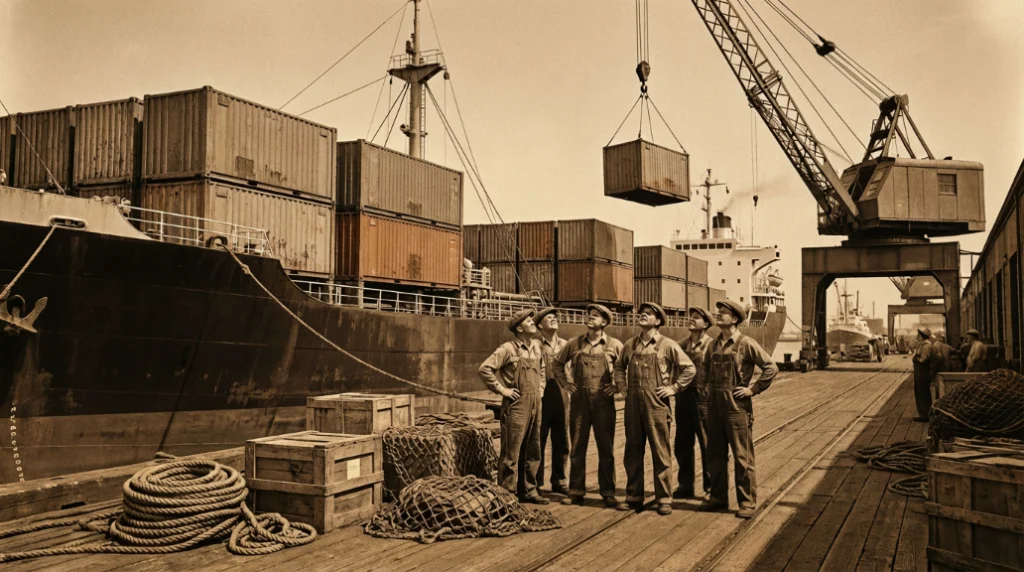
- Before containers, cargo was loaded piece by piece in a slow break bulk system. Sacks, barrels, and crates moved by hand. Loading a single ship could take days.
- Loading cargo the old way cost around $5.86 per ton. Containerization dropped that to about $0.16 per ton and slashed loading time from days to hours.
- The U.S. Army created smaller standardized steel boxes called CONEX containers during the Korean War. By 1965, they had over 100,000 of them. McLean later cited CONEX as inspiration for his larger commercial system.
- The first purpose-built container ship, the Gateway City, entered service in 1957 after the Ideal X experiment proved the concept worked.
- Early cargo containers came in whatever sizes companies felt like making: 8ft, 10ft, 20ft, 24ft, 35ft, and 40ft lengths. Every port needed different equipment. The chaos lasted until the late 1960s when the International Organization for Standardization established common sizes and fittings.
- The global standard became 20-foot and 40-foot shipping containers, 8 feet wide and about 8.5 feet tall, with universal corner castings that any crane or chassis can grab.
- Containers were used heavily to supply troops in Vietnam, which pushed ports and carriers to adopt the standardized system faster.
- Economists often rank Malcolm McLean among the most influential people in modern trade because his steel box helped trigger the wave of globalization in the late twentieth century.
Shipping Container Sizes and Capacity
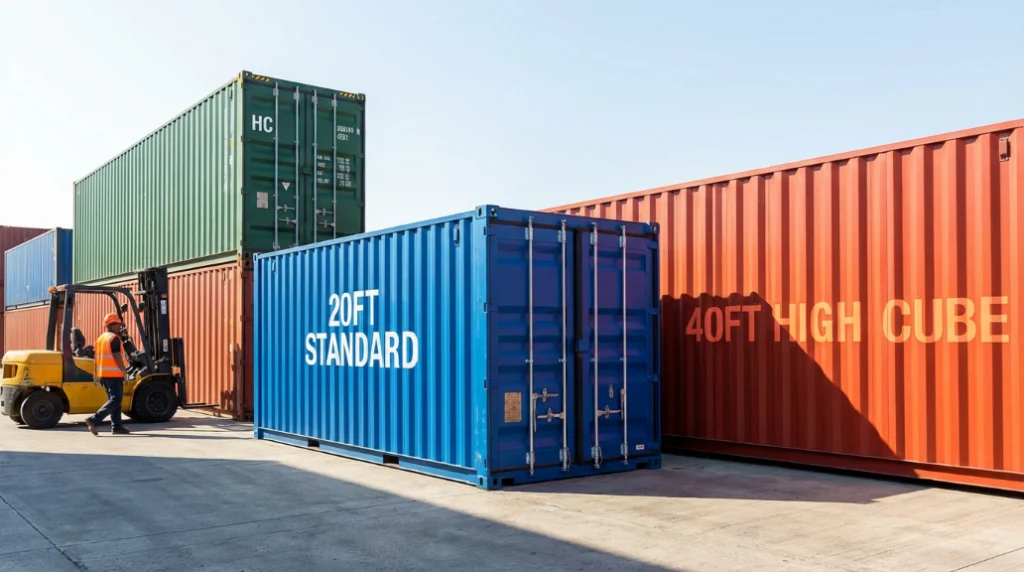
- Container capacity is measured in TEU, which stands for Twenty-foot Equivalent Unit. A 20ft shipping container equals 1 TEU. A 40ft container equals 2 TEU.
- A standard 20-foot container holds roughly 1,170 cubic feet of internal volume. That’s enough space for about 8,000 shoe boxes or 120 square hay bales.
- A 40-foot shipping container provides about 2,700 cubic feet of storage space, comparable to a 400-square-foot storage unit.
- High cube containers have the same footprint as standard units but stand 9 feet 6 inches tall instead of the standard 8.5 feet. That extra foot adds roughly 12 percent more usable volume.
- Global ports together handle over 800 million TEU every year.
- Between 17 and 20 million shipping containers are in circulation worldwide, reused trip after trip on ships, trains, and trucks.
- Mid-sized container ships carry around 5,000 TEU. The largest modern vessels carry over 24,000 TEU per sailing.
- One ultra-large ship can haul the equivalent of around 74 million bananas, or enough goods to fill a train more than 40 miles long.
- A single large container vessel can sail a distance equal to roughly three-quarters of the way to the Moon and back in one year of service. Over its life, it may circle the planet dozens of times.
- Container shipping carries a large share of world trade value while adding only a small fraction to the final cost of goods. Many products have just a few cents of ocean freight cost per unit.
How Big Are the Largest Container Ships?
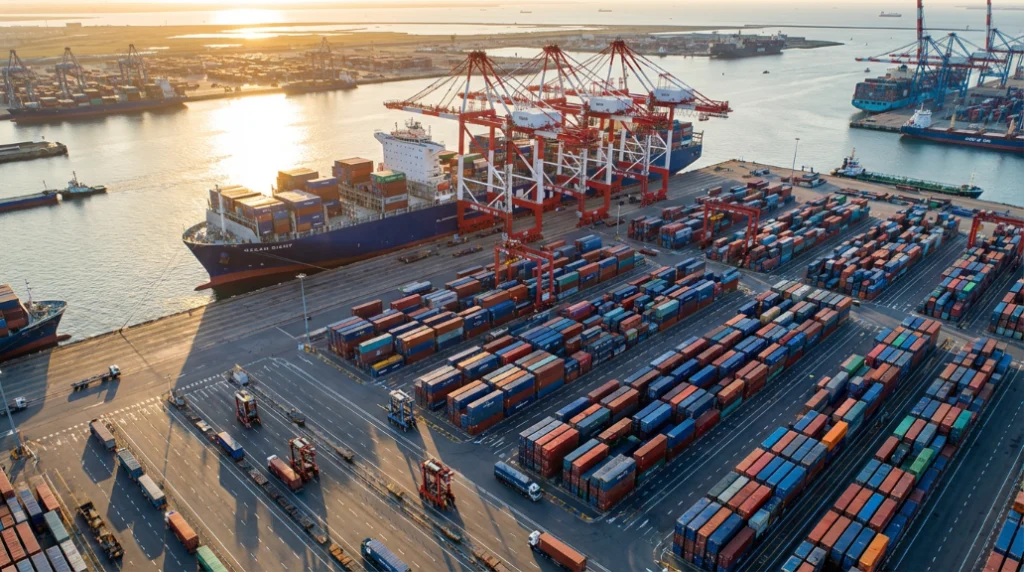
- The biggest container ships are close to 400 meters long, longer than four football fields placed end to end, and about 61 meters wide.
- Terms like Panamax, Suezmax, and Malaccamax describe size limits for passing through specific canals or straits. Some enormous Malaccamax ships were called white elephants because they were too big for many ports to handle.
- The busiest container ports like Shanghai, Singapore, and Ningbo handle tens of millions of TEU per year.
- Some giant terminals use dozens of ship-to-shore cranes that can each lift a container in a couple of minutes.
- Containers lock together and into ship structures using twistlocks and lashing systems. The stacks stay put without traditional anchors or chains.
- The busiest trade routes move millions of TEU every year between East Asia and North America or Europe, acting like conveyor belts for the global economy.
What Are Shipping Containers Made Of?
- Standard ISO shipping containers are 8 feet wide, about 8.5 feet tall, and come in lengths of 10ft, 20ft, 40ft, and 45ft. High cube options add one foot of height.
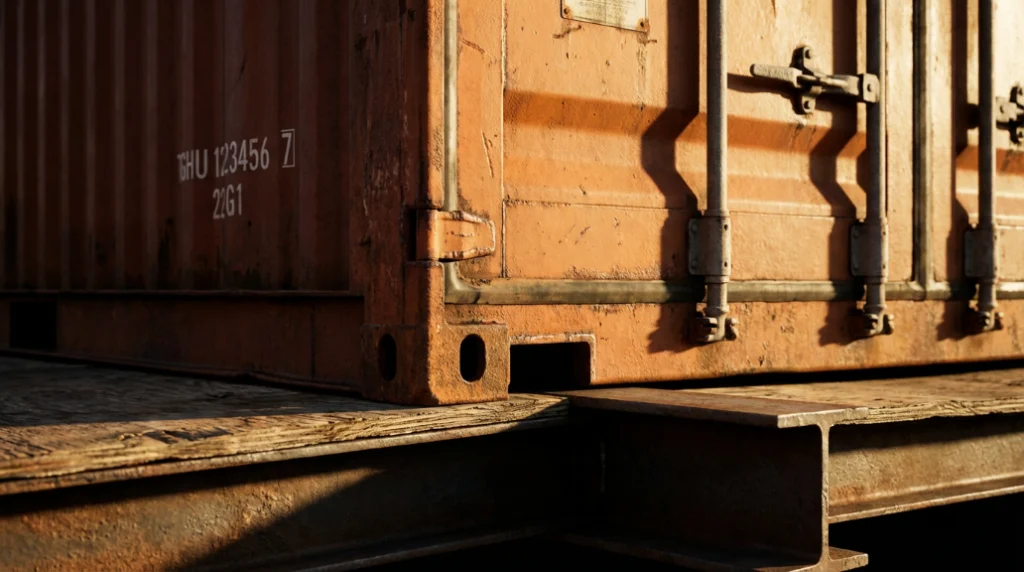
- Most steel shipping containers are built from Corten weathering steel, designed to form a stable rust-like surface that protects the deeper metal from corrosion. That orange patina is protection, not decay.
- The real strength of a cargo container is in its corner posts and corner castings. Cranes, spreaders, and twistlocks all grab those corners, and load transfers through them so boxes can stack many units high.
- Container sidewalls are corrugated to increase stiffness and resist dents while using relatively thin steel.
- Shipping container floors are heavy marine plywood or treated hardwood mounted on steel cross members, rated for forklift loads and dense cargo.
- Older container floors were sometimes treated with insecticide and preservatives to protect the wood during ocean voyages.
- A standard 20-foot shipping container has a maximum gross weight capacity in the mid-twenty metric ton range. The empty container weighs only a couple of tons; the rest is payload capacity.
- Door locking gear uses long vertical locking rods with cams at top and bottom.
- Refrigerated containers, called reefers, have built-in electric cooling units and insulated walls to move frozen food, fresh produce, medicine, or flowers at controlled temperatures.
- Specialty container types include open top containers for tall machinery, flat racks for heavy equipment, tank containers for liquids, open side containers, double door containers, and bulk boxes.
- Shipping containers can safely stack nine high when fully loaded. Each standard unit supports stacking loads up to 192,000 pounds.
How Shipping Container Identification Works
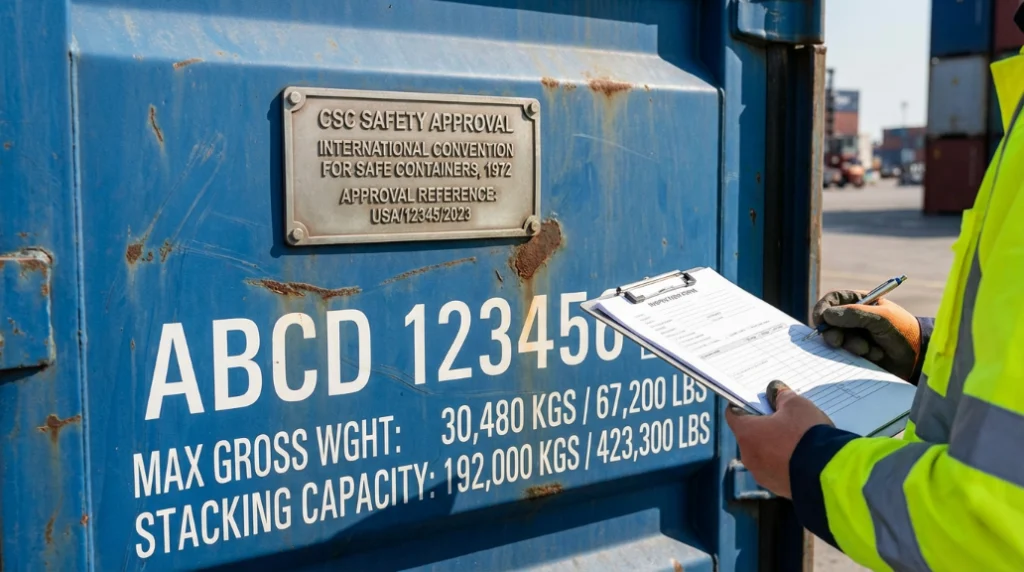
- Every ISO container carries a unique identification number made up of a four-letter owner code, a six-digit serial number, and a check digit for verification.
- The owner code on the container doors reveals which company originally owned or leased the box.
- A metal CSC plate on each shipping container shows it meets international safety rules, lists maximum gross weight and stacking limits, and displays inspection dates.
- Containers used in international shipping must pass periodic safety inspections to keep their CSC approval valid.
- A typical shipping container spends around 10 to 15 years in active ocean service before finding a second life as static storage, housing, or a modified structure.
Where Do Shipping Containers Come From?
- Around 95 to 97 percent of new shipping containers are manufactured in China thanks to large steel industry capacity and economies of scale.
- New containers rarely ship empty. They get loaded with paying cargo for their first voyage from Asia, then sold as one-trip containers after that maiden voyage, which is helpful context when buying a shipping container.
- Many one-trip shipping containers still smell like their first cargo: coffee, tea, spices, shoes, or electronics.
- Used shipping containers are graded by condition. Common grades are Wind and Water Tight (WWT), Cargo Worthy (CW), New 1-Trip, & As-Is
- A wind and water tight container is weatherproof for ground storage. No active leaks, doors seal properly, and no light shows through, though it may have cosmetic dents or surface rust.
- A cargo worthy shipping container has been inspected by a surveyor and is structurally sound for stacking and international shipping.
- Flexitanks can be installed inside standard dry containers so they can carry bulk liquids like wine, juice, or edible oil.
- Very cheap shipping containers sometimes hide problems like soft or rotted floors, heavy corrosion, bent doors, or twisted frames.
- Floor damage from heavy forklifts, point loads, and spills is one of the most common maintenance problems in older containers.
How Does Intermodal Shipping Work?
- Shipping containers move through an intermodal chain. A box can be loaded at a factory, carried by truck to a port, moved by ship, then by train, then back onto a truck without ever opening the doors.
- This sealed journey greatly reduces theft and damage compared with old break bulk cargo that sat exposed on docks and in ship holds.
- The short truck leg between a port, rail yard, or warehouse is called drayage. It’s a critical cost and timing step in the supply chain.
- Industry slang includes terms like box, can, TEU, FEU, reefer, backhaul, headhaul, and empties.
- Triangulation is the practice of routing a container from one exporter to a nearby importer so it can be reused quickly instead of returning empty to its origin.
- Shipping a small high-value item like a smartphone in a container adds just a few cents of freight cost, even across whole oceans.
What Happens to Lost Shipping Containers at Sea?
- Storms, incorrect stacking, failed lashings, and rough seas can knock containers overboard. Not every cargo container completes its trip.
- In a typical year, only a few hundred containers are lost at sea out of roughly 250 million transported. That’s about 0.0002 percent of total movements. The year 2023 saw just 221 containers lost, far below earlier averages.
- Most overboard containers eventually fill with water and sink. Some float for a while, sometimes just below the surface, creating serious hazards for yachts and small vessels.
- In 1992, a storm in the North Pacific knocked a container of plastic bath toys into the ocean. The toys, later nicknamed Friendly Floatees, washed up on beaches for decades.
- Oceanographers used reports of where those toys landed, from Alaska to the Atlantic, to study the speed and direction of major ocean currents and gyres.
- The Friendly Floatees became a famous real-world experiment that helped scientists map how floating debris moves around the globe.
How Energy Efficient Is Container Shipping?
- Container shipping is one of the most energy-efficient ways to move large volumes of freight compared with air or road transport.
- Some newer container ships use hybrid scrubbers, large systems that wash exhaust gases to strip out sulfur and particulates before they leave the funnel.
- Air lubrication systems blow a sheet of bubbles along the hull so the ship glides on a thin layer of air and water, reducing friction and cutting fuel consumption by a few percent.
- Many container lines practice slow steaming, deliberately sailing below maximum speed to save fuel and manage capacity.
Strange and Creative Uses for Shipping Containers
- Retired shipping containers become site offices, guard shacks, workshops, retail kiosks, and storage units on jobsites and farms worldwide.
- Container homes and the broader cargotecture movement turn steel boxes into houses, studios, dorms, and hotels. Designers often stack and cut multiple units into striking configurations.
- Vertical farming startups build hydroponic farms inside insulated containers, growing leafy greens year-round in parking lots, on rooftops, or in harsh climates.
- Shipping containers get converted into backyard swimming pools and hot tubs. Once modified and lined, a crane can drop a plug-and-play pool into a tight yard.
- Pop-up malls and markets built from stacked containers have appeared in cities like Christchurch and London, offering quick-build retail space with an industrial aesthetic.
- Stadium 974 in Qatar was a World Cup stadium assembled from 974 shipping containers and modular steel. The number matches Qatar’s international dialing code. It was designed to be dismantled and reused.
- Containers have been used as structural components in bridges, including a long pedestrian bridge in Tel Aviv where steel boxes serve as load-bearing elements.
Military and Emergency Uses for Shipping Containers
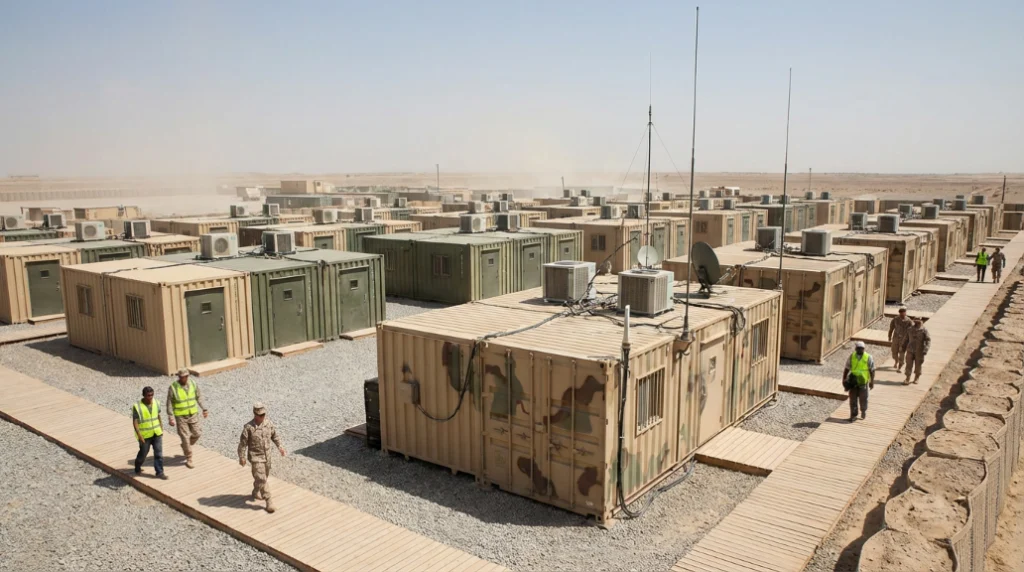
- Modern militaries use containerized housing units, called CHUs, where each unit houses two to four soldiers with bunks, desks, and climate control. In large bases, thousands of CHUs create entire container towns with streets and neighborhoods.
- Shipping containers serve as mobile command centers, communication hubs, medical clinics, and power units that can be shipped into disaster zones and set up quickly. Heavy equipment including tanks, armored vehicles, and even small submarines can be transported inside specialized containers or flat racks.
E&S Equipment Sales has worked with shipping and storage containers since 2010, serving Florida, Georgia, and Eastern Alabama. Contact Us today to get a quote on a shipping container.
0 Comments